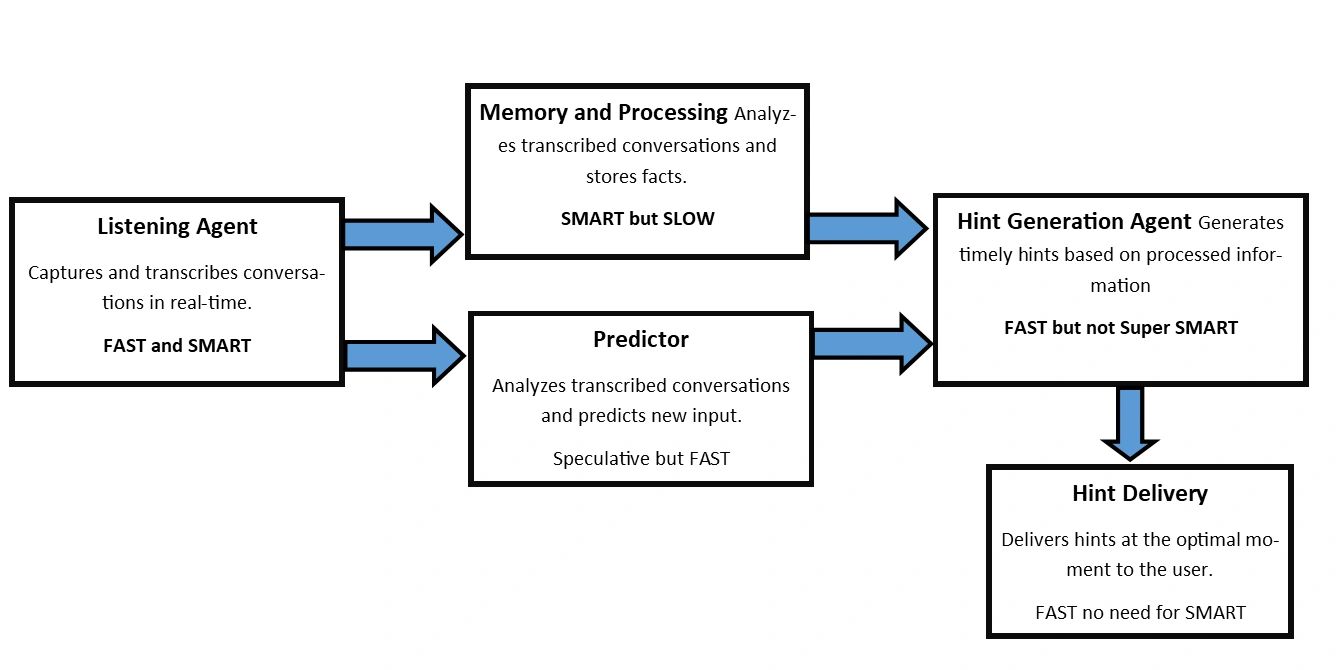
The design for the AI-driven hint generator for people with brain disabilities involves several agents working together to capture, analyze, and respond to conversations in real-time. We want to use this blog to analyze its components, identify potential shortcomings, and define improvements.
Analysis of Design Components
Listening Agent:
- Function: Captures and transcribes conversations in real-time. This works well and is proven technology.
- Strength: Described as "FAST and SMART," implying efficient and accurate transcription.
Memory and Processing:
- Function: Analyzes transcribed conversations and stores facts. Works very well but speed is a concern.
- Strength: "SMART but SLOW," indicating a focus on depth of analysis and storage of useful information.
- Shortcoming: Slowness could be a problem in scenarios requiring quick responses.
Predictor:
- Function: Analyzes transcriptions and predicts new inputs.
- Strength: "Speculative but FAST," suggesting it makes quick, though possibly less accurate, predictions.
- Shortcoming: Speculative nature could lead to incorrect or irrelevant predictions.
Hint Generation Agent:
-
- Function: Generates hints based on processed information.
- Strength: "FAST but not Super SMART," implying it provides quick responses that may lack depth or contextual accuracy.
- Shortcoming: The hints generated might not always be contextually appropriate or highly accurate.
Hint Delivery:
-
- Function: Delivers hints at the optimal moment to the user.
- Strength: "FAST, no need for SMART," suggesting it prioritizes speed over accuracy.
- Shortcoming: The lack of intelligence in delivery might result in delivering hints at inappropriate times.
Shortcomings Identified So Far
Latency in Response:
-
- The "Memory and Processing" component is described as slow, which could result in delays or incomplete information available in generating relevant hints, especially in fast-paced or real-time conversations.
Lack of Contextual Awareness:
-
- The "Hint Generation Agent" is described as not being "Super SMART." This could lead to hints that are not fully contextualized to the user's current conversation or state, reducing the effectiveness of the hints.
Speculative Predictions:
-
- The "Predictor" is speculative and fast, which might result in many false positives, where the system predicts inputs that do not match the user's actual needs or context.
Inflexible Hint Delivery:
-
- The "Hint Delivery" component lacks intelligence, potentially delivering hints at non-optimal times, which could be distracting or unhelpful to the user.
Improvements We are Working On
Enhance Contextual Understanding:
-
- Improve the "Hint Generation Agent" by incorporating more contextual analysis. This could involve using natural language understanding models that take into account the entire conversation's context, emotional tone, and the user's cognitive state.
Improve Speed of Memory and Processing:
-
- Optimize the "Memory and Processing" module to reduce latency. This could be achieved through more efficient algorithms or parallel processing techniques that allow for quicker fact retrieval and analysis. This may also be simply a choice of models new models both local and cloud emerge almost hourly.
Integrate Real-time Feedback Loop:
-
- Introduce a feedback loop mechanism where users or caregivers can provide feedback on the relevance and timing of hints. This feedback can be used to continuously improve the system's performance and accuracy.
Combine Predictive and Reactive Approaches:
-
- Instead of relying solely on speculative predictions, consider a hybrid approach where the "Predictor" cross-references predictions with real-time data to validate or adjust predictions, increasing the accuracy of the hints provided.
Adaptive Hint Delivery System:
-
- Develop a more intelligent "Hint Delivery" system that adapts to the user's pace, conversation flow, and preferences, delivering hints in a less intrusive and more context-aware manner.
Incorporate Machine Learning for Continuous Improvement:
-
- Use machine learning models to learn from past interactions and improve the system's hint generation and delivery accuracy over time. This adaptive learning could help tailor the system's responses more closely to individual user needs.
We continue to press forward improving the design so it can become more robust, efficient, and better suited to assist individuals with brain disabilities in real-time conversations.