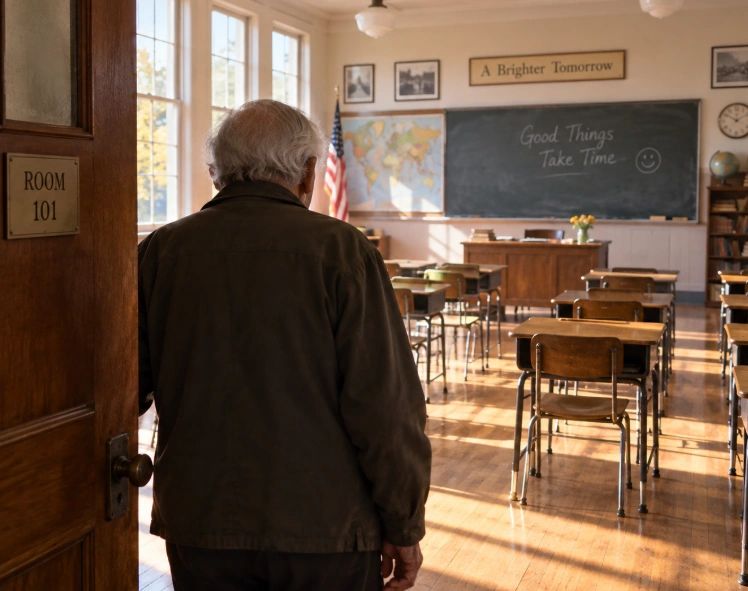
There is a fundamental difference between an AI that can hold a conversation and an AI that can learn how to support a particular person over time.
That distinction is becoming increasingly important as we develop Levago Companion.
Large language models have made conversation remarkably easy to produce. An AI can discuss the weather, answer questions, tell jokes, summarize the news, or ask someone about their childhood.
Those capabilities are useful.
But for an aging person—or someone experiencing mild cognitive impairment (MCI) or dementia—they may not be enough.
The more important question is:
Can the system learn what actually reaches this person?
Which photograph causes them to stop and look?
Which song produces a smile?
Which person from their past generates a story?
Which subjects repeatedly create engagement?
Which memories have become uncomfortable?
When should the system ask another question?
And when should it simply become quiet?
That is the thinking behind a new capability we are developing at Levago: an Adaptive Reminiscence System.
It represents an important step beyond building another conversational robot.
Reminiscence is already an established idea
Reminiscence therapy isn't new, and we shouldn't pretend that it is.
It is a well-established non-pharmacological approach that uses photographs, music, objects, places, and stories to encourage people to recall and share experiences from their lives.
This approach is particularly interesting in dementia because older autobiographical memories can sometimes remain accessible even as the ability to form or retrieve more recent memories becomes impaired.
The goal isn't to restore memories that have been lost.
It is to work with abilities and memories that remain—to support identity, conversation, emotional connection, and engagement. Our recent landscape review found an active field of digital reminiscence products and research systems already exploring many variations of this idea.
And the scientific picture is encouraging but appropriately nuanced.
A 2026 systematic review and meta-analysis of digital reminiscence therapy found a possible benefit for behavioral and psychological symptoms of dementia. Interestingly, personalized and socially engaging approaches appeared most associated with favorable outcomes. But the researchers did not find consistent significant benefits for cognition, mood, quality of life, or communication and engagement across the available randomized trials. The studies were relatively small and varied considerably in their methods. (Springer Link)
That matters.
We're not claiming reminiscence cures dementia.
We're asking a different question:
Can technology become substantially better at helping families discover and sustain the kinds of interactions that still create meaning?
From personalization to adaptation
There is an important difference between something being personalized and something being adaptive.
A personalized system might know:
Mary is his wife.
He grew up in Abilene.
He served in the Army.
He loved fishing.
Here are 500 family photographs.
That is valuable. In fact, much of Levago already does this through biography, photographs, family-confirmed information, and persistent memory.
But an adaptive system goes further.
It observes what happens.
Suppose Levago displays a photograph of a lake cabin.
The person begins talking for eight minutes.
The next time the cabin appears, another story emerges.
A photograph of an old workplace produces almost no response.
A particular wedding photograph consistently creates engagement.
Stories about military service once produced conversation but now appear to cause distress.
Those interactions contain information.
An adaptive system should learn from them.
Our working definition is a closed loop: maintain an inspectable model of meaningful and potentially sensitive cues; choose the next photograph, subject, question—or silence—from that model; observe what happens; update the model; and make those changes visible and correctable by the family.
That is much more than remembering someone's birthday.
It is learning how that individual responds to their own life story.
Why this could matter before dementia
This concept isn't relevant only after someone has developed significant dementia.
It may be particularly interesting during ordinary aging and MCI.
MCI describes cognitive changes greater than expected with normal aging but not severe enough to substantially eliminate independent everyday functioning.
This creates an important window.
Someone may still be capable of telling rich stories, identifying the people in photographs, explaining relationships, describing what mattered to them, and correcting the system when it gets something wrong.
In other words, the best time to build a map of someone's meaningful memories may be while that person can still help build the map.
Over months and years, the system can potentially learn something deeper than a static biography.
Not simply:
John owned a boat.
But:
Photographs of the boat reliably produce conversation.
Not simply:
Mary was John's wife.
But:
Stories about Mary remain highly meaningful, although certain periods surrounding her illness are upsetting.
That distinction could become extremely important as cognitive abilities change.
The system isn't starting from scratch after a diagnosis.
It has history.
The system should change because the person changes
This may be the most important concept behind adaptive reminiscence.
People aren't static.
Neither is dementia.
A photograph that creates joy today could create confusion two years from now.
A subject that once produced an hour of storytelling may eventually become exhausting.
Time of day may matter.
The presence of a particular family member may matter.
The person's ability to follow a complicated story may change.
That's why a static biography, however detailed, isn't enough.
The system has to continue learning.
Research groups are beginning to confront similar questions. A 2025 user-centered study behind the KeepsakeBox prototype found that caregivers wanted systems capable of incorporating emotional responses so reminiscence sessions could change over time and avoid material associated with agitation or aggression. (Frontiers)
Our own landscape review found several forms of “adaptive” reminiscence emerging in research: systems that personalize biographical content, respond to emotion, change cognitive difficulty, help therapists select prompts, or alter conversational behavior based on engagement. But these approaches remain quite different from one another, and long-term adaptive use in the home remains relatively underexplored.
That is the area we find particularly interesting.
The family has to remain in the loop
There is another critical difference between what we are envisioning and an autonomous AI companion.
The AI should not become the authority on someone's life.
The family should.
If Levago concludes that a photograph is important and the daughter says, “Dad hates talking about that,” the daughter wins.
If the AI associates the wrong person with an event, the family needs to correct it.
If a previously enjoyable subject becomes distressing, it needs to be reduced or removed.
Our white paper therefore identifies three things that should eventually be measured explicitly: personalization, safety, and reliability.
Did the system select something genuinely meaningful to this person?
Did it avoid or respond appropriately to distress and disputed information?
Did it actually behave consistently enough in a real home to be useful?
Those questions are considerably less glamorous than demonstrating an AI carrying on an impressive conversation.
They're also much more important.
Sometimes the right response is silence
There is another capability I think intelligent companions will need to learn.
When not to talk.
Imagine Levago displays a photograph.
Dad begins telling his daughter a story.
A conventional conversational AI may detect a pause and immediately jump in with another question.
That's technically impressive.
It's also potentially the wrong thing to do.
If father and daughter are now talking to each other, the AI has succeeded.
Become quiet.
This relates directly to something we've written about before: the purpose of Companion isn't to replace human companionship.
It is to help human companionship happen.
The adaptive system therefore isn't simply deciding what to say next.
Sometimes it should decide:
Don't say anything.
There may be benefits for the caregiver too
Reminiscence isn't necessarily valuable only to the person experiencing cognitive decline.
A 2026 pilot randomized clinical trial involving 68 dementia caregiver–care recipient dyads evaluated a digital reminiscence platform called Living Memory Home for Dementia Care Pairs.
After only two weeks, caregivers using the reminiscence intervention experienced a greater reduction in predeath grief than the control group. The researchers appropriately described this as preliminary evidence requiring a larger confirmatory trial, but the result highlights something important: dementia changes relationships, not simply cognition. (DOI)
Families experience the gradual loss of reciprocity, recognition, shared experiences, and ordinary conversation.
Reminiscence can create another pathway into the relationship.
A photograph isn't simply a memory cue.
Sometimes it's something a father and son can talk about when neither knows what else to say.
This is not cognitive surveillance
There is another tempting direction for AI that we need to approach carefully.
If a system interacts with someone for years, it could potentially observe changes in speech, engagement, topic recognition, response time, or patterns of interaction.
That may someday prove useful.
But we should be cautious about turning a companion into an invisible diagnostic system.
Our immediate interest is much simpler.
We want to understand whether the system itself is becoming better at supporting the person.
Are conversations becoming more personalized?
Are we finding the photographs and stories that matter?
Are we avoiding topics that cause distress?
Are family members correcting the system less often?
Does the device reliably create opportunities for engagement?
Those are measurable questions.
And they can be studied without pretending the system is diagnosing Alzheimer's disease.
Beyond the chatbot
AI companionship is going to become commonplace.
Soon there will be thousands of products capable of carrying on pleasant conversations.
That alone will not be enough.
For people who are aging or experiencing cognitive change, I believe the more meaningful challenge is creating systems that develop a relationship with the person's history without pretending to replace their human relationships.
A system that remembers.
A system that observes.
A system that adapts.
A system the family can correct.
A system that understands that something meaningful six months ago may no longer be meaningful today.
And a system intelligent enough to recognize that its ultimate purpose isn't to maximize engagement with the AI.
It's to maximize engagement with life and other people.
That's the direction we're pursuing with Levago Companion.
The conversational AI is important.
But increasingly, I think the intelligence behind the conversation matters much more.
Don't just ask, “Can the AI talk?”
Ask:
“Can it learn what still matters?”
And then perhaps the most important question of all:
“Can it use what it learns to help us stay connected to one another?”
That's the system we want to build.
Sources
Our development direction is summarized in Levago's September 2026 working paper, Adaptive Reminiscence Systems for People Living with Dementia and Family Caregivers at Home.
The external research discussed above includes the 2026 BMC Neurology systematic review and meta-analysis of digital reminiscence therapy, the 2026 JAMA Network Open pilot randomized trial of digital reminiscence for caregiver predeath grief, and the 2025 Frontiers in Medicine user-centered study of assistive technology for reminiscence therapy. (Springer Link)