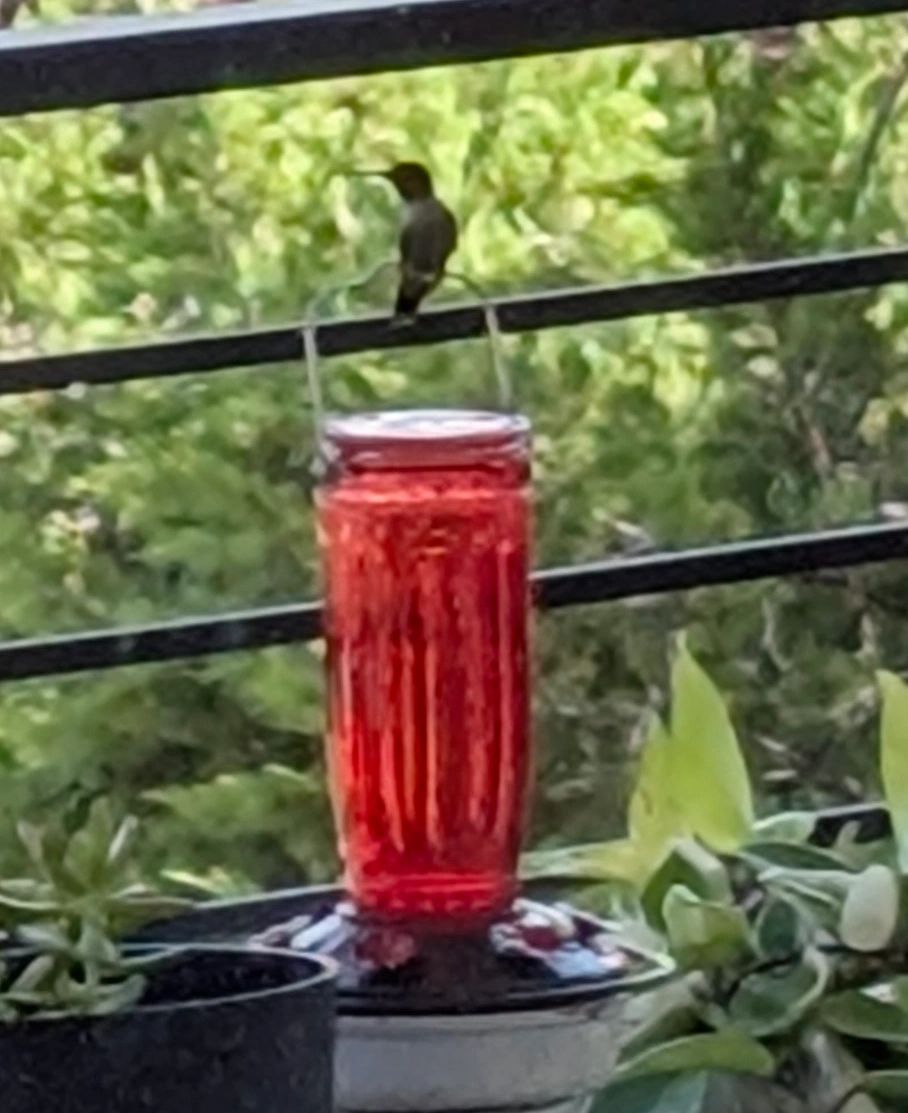
This morning I watched a tiny hummingbird sitting proudly on top of our feeder.
He had arrived first.
As far as he was concerned, that apparently made it his.
Hummingbirds are remarkably territorial. Once one discovers a reliable source of food, it may spend an extraordinary amount of energy defending it.
Another hummingbird arrives.
The resident launches.
What follows looks like a miniature aerial battle—diving, dodging, chasing, circling, and attacking at speeds that seem ridiculous for something that weighs less than a nickel.
Eventually, everyone gets tired.
A temporary truce seems to emerge.
They return to the feeder, drink from the same abundant supply, recover their energy...
...and then blast off and start fighting again.
Watching them, I realized how familiar this looked.
I've been in those meetings.
The Zero-Sum Company
The hummingbird doesn't understand something important about the feeder.
There is more food coming.
From its perspective, another bird drinking is a threat. Every ounce consumed by someone else is an ounce unavailable to him.
It's a zero-sum world.
So defending the resource makes perfect sense.
But we know something the hummingbird doesn't.
The feeder can be refilled.
There is enough.
In fact, if the birds stopped fighting, they would consume less energy and probably all end up better fed.
Organizations can fall into exactly the same trap.
People begin protecting budgets, responsibilities, titles, headcount, information, relationships and—perhaps most destructively—ideas.
Someone proposes something new and another person doesn't hear:
"Here's an opportunity."
They hear:
"Here's a threat."
Whose project is this?
Who gets the credit?
Does this diminish my role?
Why wasn't my department consulted?
Who authorized this?
What happens to my budget?
And suddenly everyone is airborne.
Diving.
Dodging.
Defending.
Attacking.
Eventually there is a meeting where everyone becomes exhausted enough to agree on something.
For a moment, everyone drinks from the same feeder.
Then the meeting ends.
And the dogfight begins again.
The Hummingbird at the Top
The little bird in my photograph particularly amused me.
He was perched above the feeder like a king surveying his kingdom.
Tiny.
Alert.
Suspicious.
Apparently enormously pleased with himself.
From his perspective, he had won.
But what exactly had he won?
He was spending much of his day guarding a resource that wasn't actually scarce.
That may be the most dangerous organizational hummingbird of all.
Not necessarily the openly difficult employee.
It's the person who has become successful inside the system by defending territory.
They know how to stop things.
They know which meetings matter.
They know whose approval is required.
They know how to raise enough objections that an idea eventually dies from exhaustion.
And because this behavior can look like diligence, experience, risk management, or "protecting the business," organizations sometimes reward it.
Eventually, the hummingbird gets promoted.
Now he has a bigger feeder to defend.
Innovation Rarely Dies Dramatically
We like to imagine failed innovation as a grand strategic mistake.
Usually, I think it dies much more quietly.
Someone has an idea.
Someone else attacks it.
The person modifies it.
Another department objects.
A committee gets involved.
Someone worries about precedent.
Someone requests more analysis.
Another meeting is scheduled.
Six weeks later, nobody can quite remember why the idea was exciting in the first place.
Nothing was explicitly killed.
Everyone was simply very responsible until it died.
And that's why this behavior is so dangerous.
A company can contain intelligent, hardworking, well-intentioned people and still accomplish remarkably little.
Everyone is moving.
Everyone is busy.
Everyone is exhausted.
From a distance, it looks like tremendous activity.
So does a hummingbird dogfight.
Culture Doesn't Begin in the Conference Room
It's tempting for leadership to blame this on employees.
I don't think that's where the explanation usually begins.
People learn very quickly what an organization actually rewards.
If people who share credit get overlooked while people who protect territory get promoted, the lesson is clear.
If challenging the status quo damages careers while defending it is safe, people adapt.
If leaders tolerate brilliant jerks because they "get results," other people learn that the behavior is acceptable.
If executives distance themselves from the actual workings of the organization and experience reality primarily through polished presentations from the people beneath them, territorial behavior can flourish almost invisibly.
Eventually, people aren't collaborating to create something larger.
They're competing to control pieces of what already exists.
Leadership didn't necessarily order that culture into existence.
But leadership probably permitted it.
Hiring and Promotion Matter More Than Slogans
Companies spend enormous amounts of time defining their values.
Collaboration.
Innovation.
Courage.
Trust.
Put them on the wall.
Put them on the website.
Put them in the annual report.
But employees don't learn culture from the wall.
They learn it by watching who gets hired, who gets listened to, who gets promoted, and what behavior leadership tolerates.
Promote the territorial hummingbird and you've made a cultural announcement far louder than anything printed in the employee handbook.
Promote the person who makes other people better and you've made a different one.
This becomes increasingly important as an organization grows. Informal trust becomes harder. Departments develop identities. Resources acquire owners. Communication becomes structured. Layers appear.
None of that is inherently bad.
But it creates more places to perch.
Look in the Mirror
If your organization hasn't produced a genuinely important new idea in a long time, there are many possible explanations.
The market may be difficult.
Capital may be constrained.
Technology may not be ready.
Your people may need different skills.
But leaders should at least consider another possibility:
Maybe everyone is spending too much energy defending the feeder.
Or perhaps the problem is the bird who is supposed to be watching the feeder.
Maybe you're too distant from what is actually happening while still insisting on being part of every important decision.
You attend meetings you don't really contribute to. You leave early. You half-listen while driving to the next offsite. You remain copied on everything and accountable for everything, yet rarely stay close enough to resolve anything.
It's a strange form of micromanagement by not micromanaging.
You haven't delegated real authority, because everyone still believes your approval matters.
But you haven't provided enough attention to give that approval—or to clearly say it isn't needed.
So your absence becomes a decision.
Your silence becomes a veto.
Someone says:
"We should probably wait until the boss weighs in."
Someone else says:
"I'm not sure they're comfortable with this."
Nobody actually knows what you think.
But everyone has learned that moving without you carries more risk than waiting for you.
And so nothing moves.
The king hummingbird doesn't even have to defend the feeder anymore. The other birds do it for him.
That's an especially dangerous leadership failure because, from the leader's perspective, it can look like empowerment.
"I'm not micromanaging. I trust my people."
But real delegation isn't absence.
It's clarity.
People need to know what decisions they own, what decisions you own, when your involvement is actually required, and—most importantly—when they have permission to move without you.
Otherwise, you haven't empowered the organization.
You've simply created an empty perch that everyone keeps looking toward.
Maybe You're the Hummingbird
And if you're the leader, don't immediately start looking around the organization for hummingbirds.
Look in the mirror first.
Do people bring you unfinished ideas, or only ideas that have already survived five layers of political protection?
Can someone disagree with you without paying a price?
Do you reward people who challenge your favorite assumptions?
When something succeeds, do you care who gets the credit?
Have you promoted people who create energy—or people who consume everyone else's energy?
Do your people actually have authority, or do they merely have responsibility while waiting for your approval?
And perhaps the hardest question:
Are you sitting on top of the feeder yourself—even when you're not actually there?
Wary.
Protective.
Certain that your position gives you a better view of everything happening below.
Or perhaps so distant that you've left an empty perch everyone is afraid to fly past.
Neither is leadership.
It isn't a particularly comfortable realization.
That's probably why it's worth considering.
There is something almost comical about watching these tiny birds expend enormous amounts of energy fighting over an abundant resource.
It's considerably less funny when organizations do it.
Every hour spent protecting territory is an hour not spent creating.
Every meeting devoted to positioning is a meeting not devoted to solving.
Every good idea killed because it threatens someone's perch is an opportunity handed to somebody else.
And every leader who allows that culture to flourish eventually owns the result.
The hummingbirds eventually become exhausted enough to share the feeder.
Companies don't always get that chance.
Sometimes the competitors arrive while everyone inside is still fighting.
So if your organization is extraordinarily busy but somehow not accomplishing anything extraordinary, don't schedule another meeting to figure out why.
Take a look at the feeder.
Then take a look in the mirror.
Maybe the problem isn't the other birds.
Maybe you're perched on top.
Get off the feeder.
There's enough nectar.
Build something.