Artificial intelligence is becoming extraordinarily good at giving us answers.
Want to understand what happened at the Battle of the Bulge? Ask.
Want to know how to repair a tractor? Ask.
Want the important findings from a 40-page research paper? Ask.
For most of human history, acquiring knowledge required a journey. We found a book, newspaper, manual, or research paper and worked our way through it. Along the way, we encountered ideas we weren't looking for. We paused. We wondered. We made connections.
AI is rapidly changing that equation.
Increasingly, we can simply ask for the specific piece of knowledge we need and receive it almost instantly.
That is an extraordinary advance.
But I wonder whether something important could disappear along the way.
Because reading isn't simply an inefficient way of retrieving information.
Reading is an experience.
And for people living with dementia, that experience may be particularly valuable.
An idea from Reading2Connect that made me think differently
This blog was inspired in large part by an excellent whitepaper from Reading2Connect®, Exploring the Relationship Between Reading and Dementia.
Reading2Connect has devoted its work to something both simple and profound: bringing the joy of reading back to adults living with cognitive changes. The organization develops age- and dementia-friendly reading materials and trains caregivers and support partners in what it calls its “Invitation to Read” methodology.
Their work caused me to think differently about something we are building at Levago.
The whitepaper challenges a common assumption about dementia: when someone stops reading conventional books, newspapers, or magazines, we naturally assume they have lost the ability to read.
That isn't necessarily true.
The paper reviews research indicating that reading can remain functionally preserved in many people with dementia. What deteriorates may instead be many of the abilities surrounding reading: working memory, sustained attention, visual tracking, organization, and the ability to process several things simultaneously.
That's an enormously important distinction.
Perhaps the person hasn't failed the book. Perhaps the book has failed the person.
Reading2Connect's response has been to redesign the reading experience around the abilities that remain.
Larger, high-contrast text. Shorter lines and sentences. More visual space. Manageable amounts of information. Engaging photographs. Adult subject matter that respects the richness of a lifetime of experience. And, importantly, interaction that doesn't turn another adult into a student being tested.
Read a little.
Stop.
Look at the photograph.
Remember something.
Say something.
Laugh.
Go somewhere unexpected.
Success isn't necessarily finishing the page.
Success is engagement.
Reading gives conversation somewhere to begin
This is where Reading2Connect's work becomes particularly relevant to our thinking at Levago.
Their whitepaper discusses Shared Reading, where literature becomes common ground between people. Someone may read aloud while another person follows along, listens, comments, remembers, or simply participates in whatever way feels comfortable.
The words provide something to react to.
A sentence can trigger an opinion.
A photograph can trigger a memory.
A story can trigger another story.
The whitepaper summarizes studies reporting encouraging findings around mood, concentration, engagement, connectedness, agitation, and self-expression. It also describes relatives and caregivers gaining new insights into the lives and interests of people they love.
That last point matters enormously.
Because the objective isn't simply reading.
It's connecting.
And that is where I see an intriguing opportunity to build upon these ideas with AI.
What if AI helped us read rather than replaced reading?
Reading2Connect has demonstrated an important principle: change the material and the interaction to meet the person where they are.
AI potentially allows us to take personalization another step further.
Imagine sitting beside your father with a Levago Companion book open between you.
Instead of presenting a conventional page filled with text, it displays three or four carefully chosen sentences in large, readable type.
The Companion reads along.
Dad hears the words while seeing them.
Then a photograph appears.
But unlike a conventional dementia-friendly book, this might be his photograph.
His farm.
His wedding.
His Army uniform.
His children.
His old Ford tractor.
And because Levago has access to his biography, the system understands some of the story surrounding that image.
Perhaps it says:
"That looks a lot like the tractor you had on the farm."
Then it waits.
Maybe nothing happens.
That's okay.
It can continue reading.
But perhaps Dad suddenly says:
"That thing never started when it was cold."
At that moment, the reading should stop.
Because the interruption may be the entire purpose of the reading experience.
His son can take over.
"Really? What did you have to do?"
Now they're talking.
The technology has done its job.
Read. See. Remember. Talk. Connect. Preserve.
This is where I think Reading2Connect's work and Levago's work are complementary rather than competitive.
Reading2Connect is demonstrating how carefully designed books and carefully designed human interaction can reopen reading to people whose cognitive changes have made conventional material inaccessible.
At Levago, we're asking:
What happens when the book itself can participate?
The book can know the person's biography.
It can select relevant material.
It can display personal photographs.
It can read aloud.
It can adjust the amount of material presented.
It can recognize when conversation has begun.
And then, importantly, it can get out of the way.
If a new memory emerges, Levago can also preserve it.
The photograph becomes connected to the story. The story becomes part of the biography. And perhaps six months later, that same memory becomes the starting point for another conversation.
The cycle becomes:
Read → See → Remember → Talk → Connect → Preserve → Return.
That isn't replacing reading.
It's using AI to make reading increasingly personal.
The danger of making everything too easy
And this brings me back to the paradox that originally interested me.
AI will probably cause many of us to read less.
Why read an entire report when AI can summarize it?
Why work through a repair manual when AI can tell you exactly which bolt to remove?
Why read twenty pages of history when you can ask precisely what happened?
For information retrieval, this is remarkable progress.
But reading does things that information retrieval doesn't.
Reading gives the mind somewhere to wander.
We encounter things we weren't searching for.
We make associations.
We imagine.
We remember.
That inefficiency may sometimes be the point.
So perhaps one responsibility of AI shouldn't always be eliminating the journey.
Sometimes it should help us take it.
Technology in service of the person
One passage near the end of the Reading2Connect whitepaper particularly resonated with me.
The authors argue that we should be careful about viewing recreational reading for people with dementia only as “therapy.” Reading is also simply a natural human activity—something capable of expressing curiosity, imagination, humor, knowledge, independence, and personhood.
I think that philosophy is important.
Someone with dementia doesn't need every moment of their day turned into treatment.
Sometimes Dad doesn't need therapy.
Sometimes he needs an interesting book.
A photograph he recognizes.
A story worth hearing.
Something he can still participate in.
And someone willing to sit beside him.
That's what I hope AI can support.
Not replacing the book.
Not replacing the caregiver.
Not replacing the family.
And certainly not replacing the person.
Helping them find one another.
I'm grateful to the people at Reading2Connect® for their work and for publishing Exploring the Relationship Between Reading and Dementia. Their research and philosophy helped sharpen our thinking about what a “book” might mean in the age of artificial intelligence.
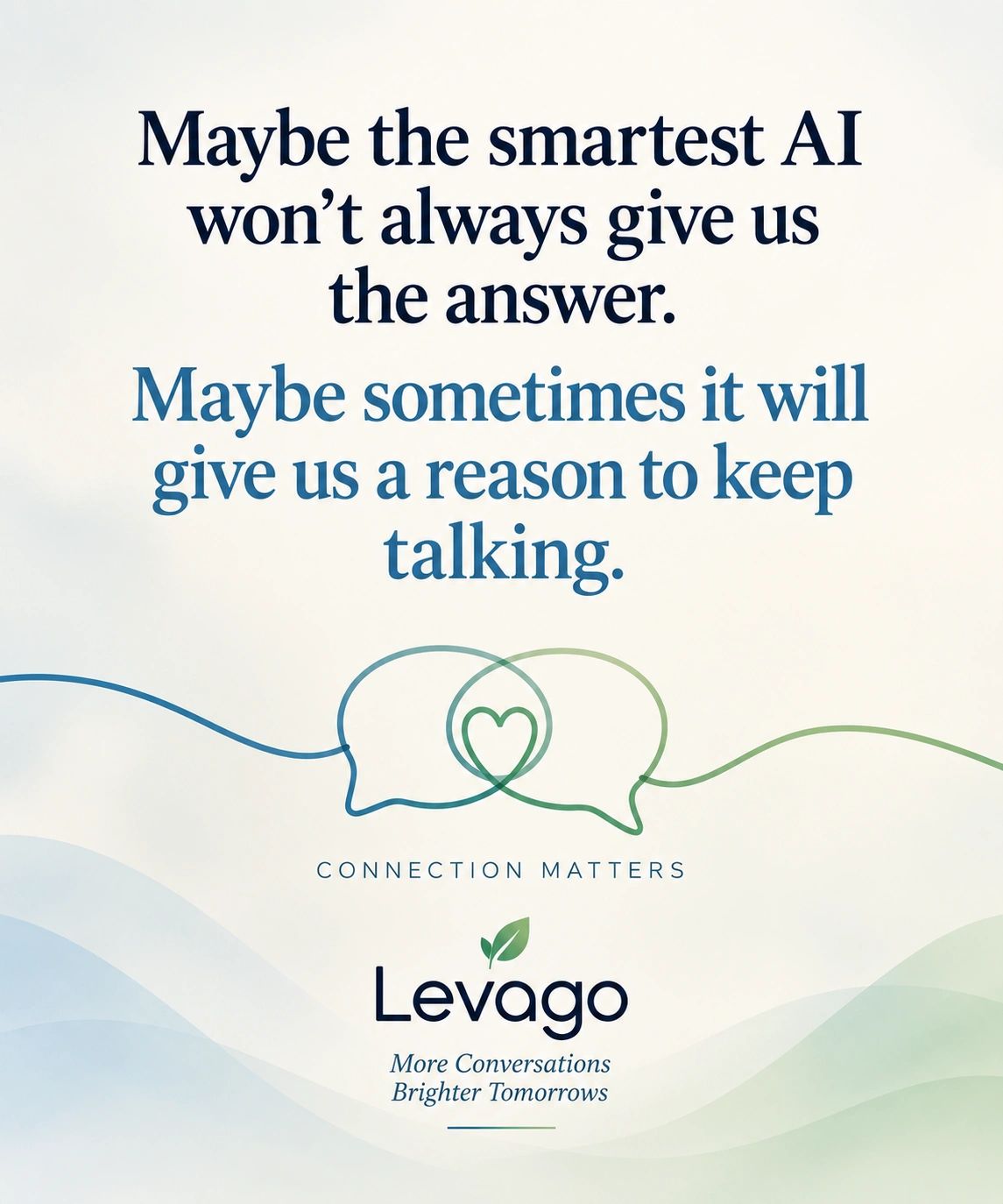
Perhaps the smartest book of the future isn't the one that gives us every answer.
Perhaps it's the one that knows when to show us a few words, a familiar photograph, and then wait.
Because sometimes the purpose of reading isn't reaching the end.
It's finding one another along the way.
Levago Companion
Read together. Remember together. Stay connected.
Because every life deserves to remain part of the conversation.