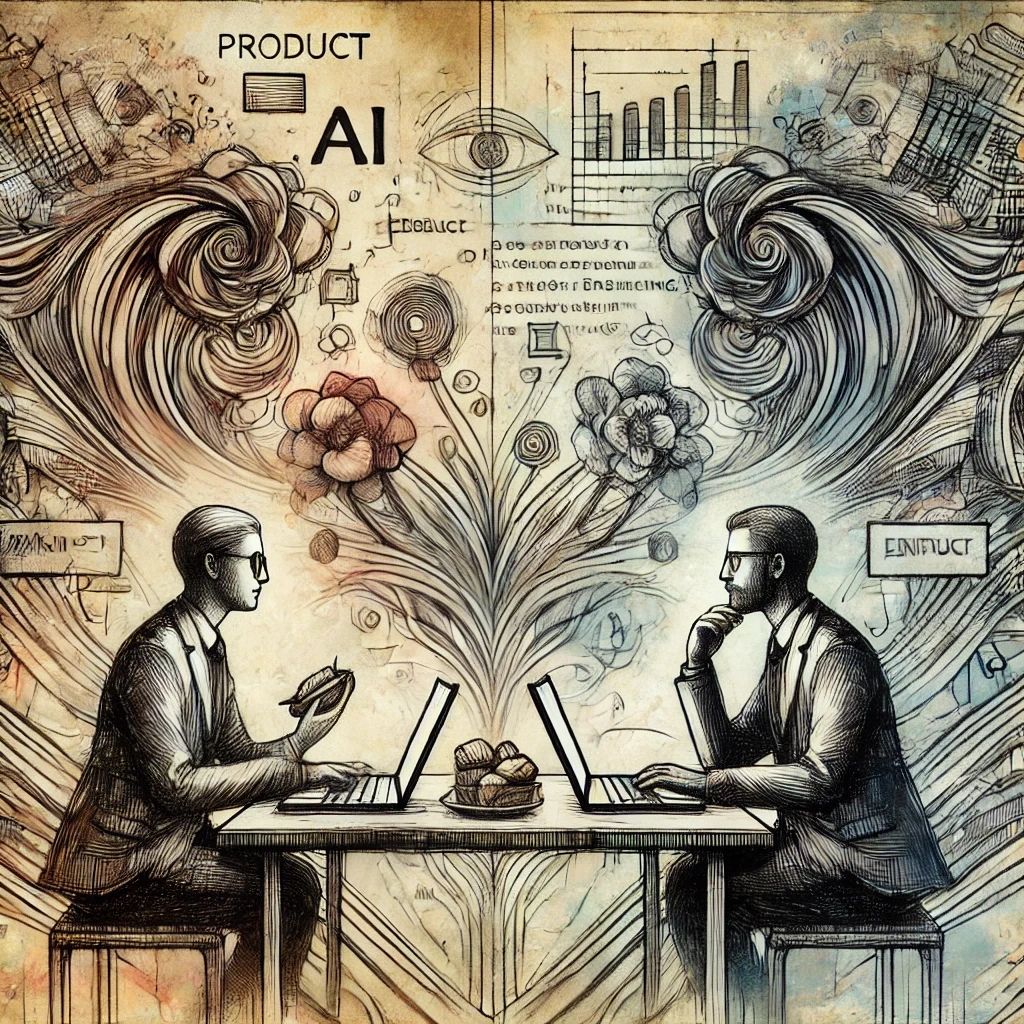
So how can just two people outperform an entire scrum team?
Let’s be clear: it’s not easy — but it’s the future.
The two-sandwich team is our answer to the bloated, sluggish world of traditional software development. It replaces a standard 5-to-8 person scrum team with just two highly motivated, cross-functional humans. And not just any two. These aren’t nine-to-fivers looking for the next JIRA ticket to check off. These are people who live for building, solving, and pushing boundaries. People for whom “work-life balance” is a meaningless phrase — not because they don’t have lives, but because the work is life. It matters. It’s vital. It’s not something you zone out for.
Frankly, I’ve always found “work-life balance” patronizing. As if your work should be so meaningless, so drudging, that it only counts as your undead third of the day. That’s not how you build the future. That’s not how you build anything worth shipping.
Two Roles. Infinite Impact.
Inside this team of two, there are distinct roles — though both members bleed into each other’s skillsets constantly.
The first person is a polymath: Product Owner, Product Manager, Systems Engineer, Test Engineer, and often a Junior Software Developer. This person must hold a crystal-clear vision of the product — always. There’s no room for hesitation, no moment of “let me check with marketing.” Decisions about user experience, feature flow, and purpose are made fast and with conviction.
The second person is a Senior Software Engineer, Architect, Designer, and System Thinker. They understand architecture deeply — not just software, but cognitive systems, user feedback loops, data flows, and AI integration. They aren’t building to spec. They’re building to intent.
Together, they never wait. If a question about the product arises, the PO/PM already knows the answer. If a debate about architecture comes up, the engineer was up all night sketching designs — not because it was a deadline, but because the question needed answering.
In traditional teams, this is where everything stalls. “We need to survey users.” “I’ll get back to you.” “I need two weeks to architect that properly.” That doesn’t happen in a two-sandwich team. The vision and the design are alive, every day, iterating faster than any sprint planning ever could.
No Sprints. No Standups. Just Output.
We don’t do sprints. We don’t assign story points. We don’t waste mornings describing what we did yesterday in three sentences.
Instead, each day, the two members decide together what matters — and then do it. Sometimes it takes 24 hours. Sometimes 3. If one of us is burnt out, we pause, rest, and re-engage the next day with full force. There are no calendars, no sprint boards, no artificial ceremonies. Just shared goals, shared ownership, and real results.
And because there are only two of us, all logistics are simple. No permissions. No scheduling conflicts. No waiting for approval. If we want to work at one of our homes, we do. If we want to hash something out in a coffee shop, we’re there. The point is we work together — physically — and push toward the same outcome, with friction not about the outcome we want but how to get there.
It’s not a utopia. It’s just efficient. And yes, we get more done than any scrum team I’ve ever worked with.
The Hard Truth About Skill and Specialization
Now, let’s not sugarcoat it — most organizations aren’t ready for this.
Why? Because they’ve built systems that rely on mediocrity. They divide labor into narrow roles, then hand out checklists and expect “alignment.” If you try to introduce a two-sandwich team inside one of these setups, you’ll hear a lot about “cognitive overload” and “sustainability.” You’ll hear people say it’s unrealistic to expect anyone to handle both product vision and technical architecture.
And for most people, that’s true.
But we’re not trying to accommodate fourth-best hires. We’re not trying to make the average developer feel better about shipping forgettable features. We’re building something that matters — AI systems that empower people with dementia, traumatic brain injury, or learning challenges to live independently.
You don’t solve that with mediocrity. You solve that with clarity, urgency, and talent.
Discipline, Process, and the Role of AI
Here’s what really sets the two-sandwich team apart: disciplined AI use.
Every piece of code generated by an LLM is reviewed, tested, and understood. We don’t just paste and pray. We use documented protocols for integrating AI output — from how prompts are structured to how context is layered to how fact-checking is handled by dedicated roles like LLMs in our architecture.
AI becomes a co-developer — not a replacement, not a guessing engine. It accelerates our thinking, fills in repetitive scaffolding, and surfaces ideas but never leads. It follows our direction, and we give it that direction with surgical precision.
When the Product Owner makes a decision, it is final. When the Engineer defines the architecture, that’s the blueprint. But both have complete visibility into each other’s space. There is no handoff. No lag. Just aligned minds moving quickly.
What You’ll Need to Build One
If you’re reading this and wondering whether you can replicate the model, ask yourself:
- Do you have two people who care deeply about the outcome — not just their role?
- Can your organization tolerate high autonomy and asynchronous intensity?
- Are you willing to throw away your sprint board and replace it with shared trust?
If not, that’s fine. Keep your scrum teams. Keep measuring productivity in story points and hours logged. But don’t expect to compete with those who’ve embraced the two-sandwich model.
Because we’re not just writing code.
We’re building systems that think, communicate, and empower. And we’re doing it faster, cleaner, and with more clarity than any waterfall, agile, or hybrid methodology can match.
Want to go even deeper? Our earlier posts on AI architecture design and reasoning-driven product loops explain how we built a five-LLM cognitive system that listens, speaks, and remembers — and why that system only works when guided by real engineers with real vision.