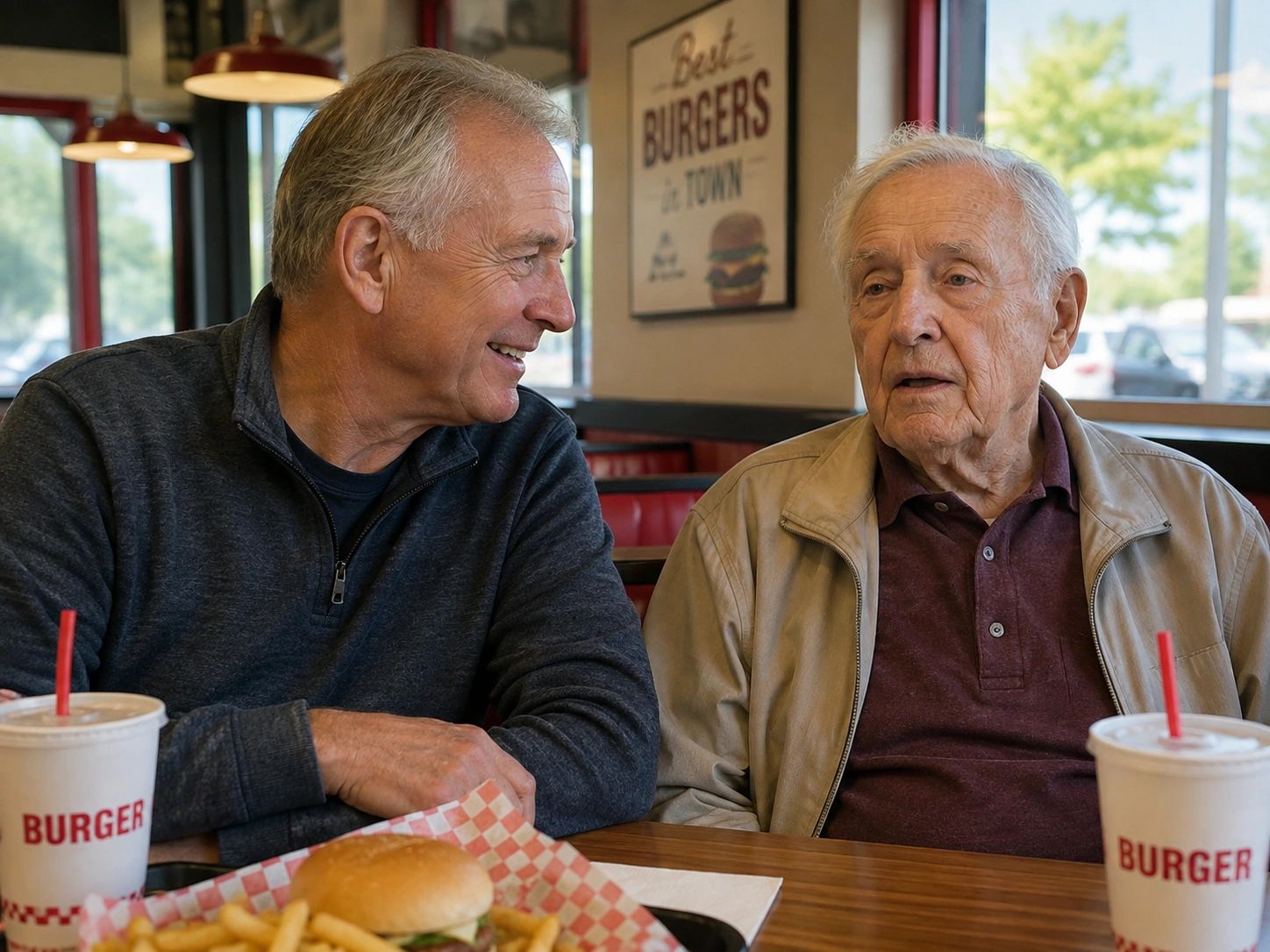
Today I was sitting in a coffee shop when I noticed two older men a couple of tables away.
One appeared to be in his seventies. He was talking almost continuously—about yard work, a tractor that needed repairing, and the ordinary things that fill our days.
After a while, I noticed that he was becoming repetitive.
From where I was sitting, I assumed I was watching two old friends. We all know that friendship: one person does most of the talking and the other is perfectly content to listen.
Then, as I got up to leave, I walked past their table and saw the other man's face for the first time.
He looked close to ninety. The resemblance between them was unmistakable. I can't know their relationship or the older man's condition, but suddenly the scene looked very different to me.
I wondered if I was watching a son trying desperately to keep a conversation going with his father.
And I recognized that seat.
I've been in it.
When someone you love begins losing the ability to participate in ordinary conversation, silence becomes complicated.
You don't want to just sit there staring at each other.
So you talk.
You talk about the weather. You talk about lunch. You talk about something that happened yesterday. You tell the same stories. You ask questions that sometimes receive answers and sometimes don't.
You keep talking because you're trying to reach the person you love.
Sometimes something works.
A name.
A song.
A photograph.
A place they once lived.
Suddenly there is a spark of recognition.
Their expression changes. A memory surfaces. For a moment, the person you remember seems to step back into the conversation.
And then the moment can disappear almost as quickly as it arrived.
Anyone who has sat in that chair understands the strange combination of love, grief, frustration, hope, and exhaustion involved.
Watching those two men today made me think about why we are building the Levago Companion.
What if there were a third voice at the table?
Not a replacement for the son.
Not a replacement for the father.
And certainly not a replacement for human companionship.
Something whose job was simply to help them find each other.
Imagine that conversation about the tractor.
Perhaps Levago knows that the older man once owned a Ford tractor. A photograph appears on the book.
The Companion might say:
"That reminds me of the tractor you had years ago. Wasn't there a story about you and John trying to get it running one summer?"
Maybe nothing happens.
That's okay.
But perhaps the older man looks at the photograph.
Maybe he says three words.
Maybe he suddenly remembers the farm.
His son recognizes the opening and asks another question.
Now the AI becomes quiet.
Father and son are talking again.
That is the product I want us to build.
The problem isn't simply memory loss
One of the things I have learned through my family's experience with Alzheimer's is that cognitive decline doesn't affect only the person experiencing it.
It changes the entire social environment around that person.
Conversation becomes harder. Friends may visit less frequently because they don't know what to say. Family members struggle to find subjects that create engagement. Caregivers increasingly carry the burden of initiating and sustaining every interaction.
Eventually, isolation can grow around someone even when that person is surrounded by people who love them.
This matters.
Research increasingly connects social isolation and loneliness with poorer outcomes in older adults and cognitive decline. Research into reminiscence therapy has also explored something caregivers have understood intuitively for generations: photographs, music, familiar objects and stories can sometimes provide pathways into memories that ordinary questioning cannot.
That is one of the scientific ideas behind Levago Companion.
But sitting in that coffee shop reminded me that the human idea may be even simpler.
Conversation needs something to hold onto.
A biography that can participate
This is why we have spent so much effort building the biographical intelligence underneath Levago.
The biography isn't simply a book someone reads.
It gives the AI context.
Who is this person?
Who did they love?
Where did they grow up?
What did they do for a living?
What photographs matter?
What stories have they told before?
What subjects cause them to light up?
What happened yesterday that might matter today?
That knowledge can give the Companion something a generic voice assistant does not possess: a deeply personal basis for finding the next meaningful thing to talk about.
And photographs make that capability considerably more powerful.
Instead of asking a person struggling with memory an abstract question—"What did you do when you were younger?"—the book can show a photograph.
There's the house.
There's the tractor.
There's Mary.
There's the wedding.
There's the fishing boat.
There's Dad in his Army uniform.
Now there is something concrete sitting between two people.
And something to talk about.
And when the spark happens, don't lose it
There is another part of this that matters deeply to me.
When a memory does surface, we should be able to preserve it.
Perhaps the photograph of the tractor prompts a story no one in the family has heard before.
The Companion can listen.
That recollection can become part of the person's biography. The photograph and story can become connected. The next conversation can build upon what was learned in the last one.
A fleeting moment of recognition doesn't necessarily have to disappear forever.
It can become part of the family's story.
This is where our two ideas—Companion and Biographer—come together.
Companion uses the story of a life to help someone engage today.
Biographer captures today's conversations so that story can live tomorrow.
One reaches backward to find memories.
The other reaches forward to preserve them.
Technology should disappear from the table
I don't want Levago to dominate conversations like the one I witnessed today.
Success would be almost the opposite.
The best interaction might be one where Levago says ten words, displays one photograph, and then becomes silent because those ten words helped a father and son talk for the next twenty minutes.
That is why the physical form of the product matters to us as well.
We aren't trying to put another computer on the table.
We're building something that looks and feels like a book—a familiar object containing photographs, stories, voices and memories. Something that belongs naturally between two people remembering a life together.
The technology should fade away.
The people should remain.
As I walked out of that coffee shop today, I kept thinking about the younger man carrying that conversation.
Maybe I completely misunderstood what I saw.
But I know the situation it reminded me of.
I have lived it.
Millions of families are living some version of it now.
They don't need AI to replace the person they love.
They don't need AI to replace themselves.
Sometimes they just need a little help finding the next memory, the next photograph, the next question—the next spark that brings someone they love back into the conversation.
Sometimes two people just need a third voice at the table.
That's what we're trying to build.
Levago Companion
Helping people stay part of the conversation—and part of their own story.
Because every life deserves to be remembered.