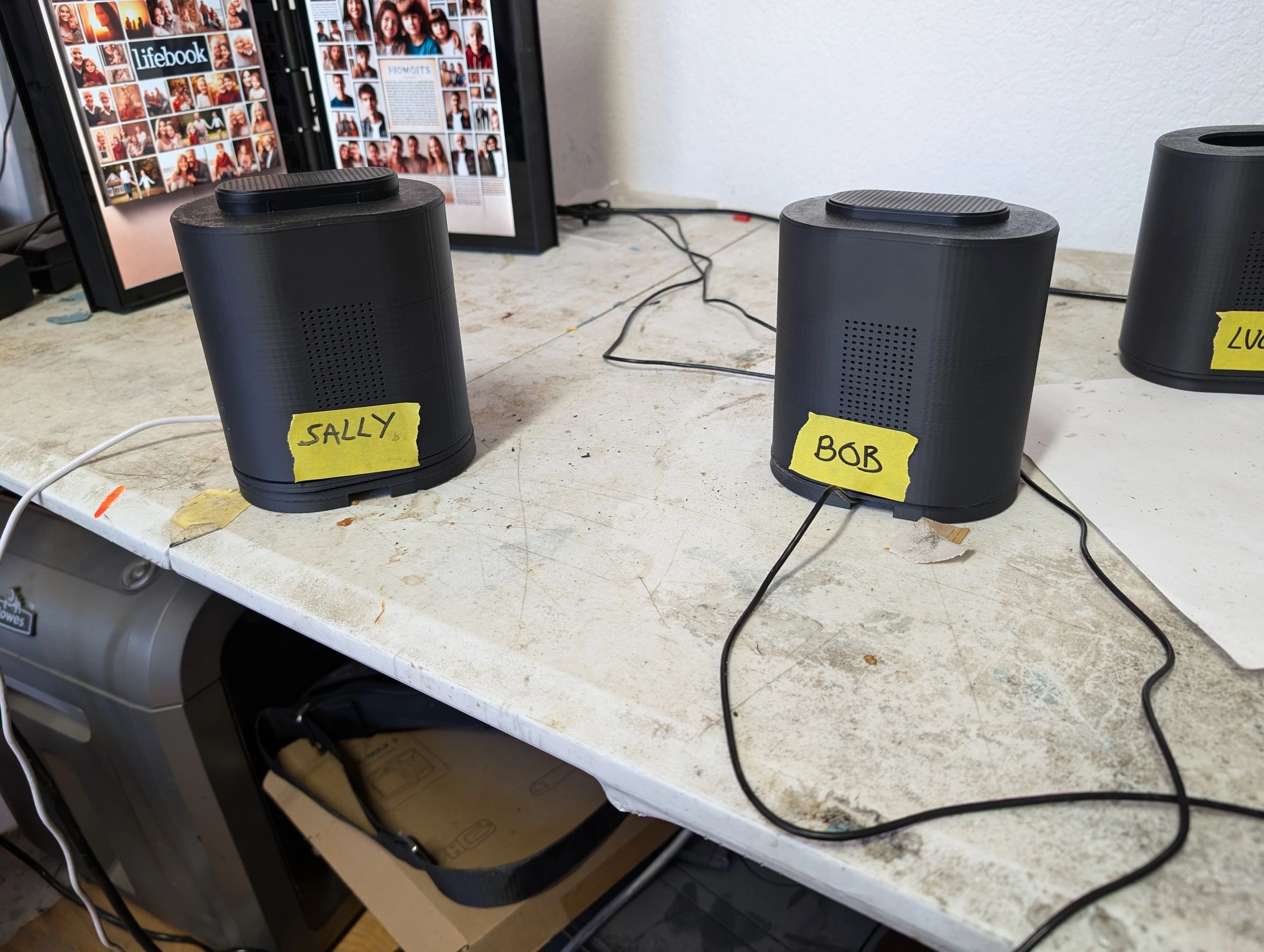
Recently, someone asked me if the “Sally Boxes” we’ve talked about are real, or if they’re just a conceptual toy. The answer? Absolutely real! But it’s worth noting—these Sally Boxes are not a product we’re planning to release. Instead, they’re a tool we developed to support our work at Voice of Reason AI. And while they may not be as polished as the idealized designs from previous blogs, they have proven to be invaluable in our development process.
Just five years ago, if you’d told me that we’d have language models capable of truly useful, nuanced interactions without the need for massive amounts of specific use-case software development, I might have been skeptical. But here we are. At Voice of Reason AI, we’re developing a social interaction tool specifically designed to help those with memory loss, and the Sally Boxes have become an essential part of our testing and development.
So, What Makes These Boxes Special?
These Sally Boxes aren’t just talking devices. They’re social interaction simulators powered by LLMs, capable of carrying on continuous conversations with each other, day and night. Each box is loaded with multiple LLMs, tuned and customized with different personalities to mimic real conversational patterns, similar to the social cues and familiar interactions that people with memory loss encounter in daily life. This allows us to generate a near-endless stream of social interactions, testing how our software performs and providing critical data every day.
Each Sally Box runs the same software that powers our VOR Audio products, with a twist: their “personalities” are adjusted to create a mix of synthetic conversations that feel authentic. This way, they’re not just testing our memory aids in isolation; they’re engaged in lifelike social exchanges that help us refine and improve the interaction dynamics of our system.
Mastering the Art of LLM Interaction
As we continue to refine the LLM interactions within each Sally Box, we’re essentially creating an array of LLMs that are learning to “talk” to each other and to users in increasingly effective ways. This layered system enables a feed-forward and feedback loop, where each interaction generates insights into how these models perform in various scenarios. It’s a dynamic learning system that’s constantly evolving, teaching us what works, what doesn’t, and what might be possible in the future.
A Glimpse Into the Future
The possibilities for interacting LLMs extend far beyond memory aids and companionship. Imagine a network of these conversational agents, not just in homes for people with memory challenges but in hospitals, care facilities, and rehabilitation centers, where they could help patients feel more connected. They could serve as digital companions that understand context, provide timely reminders, and even keep loved ones updated on a patient’s well-being.
In education, these kinds of AI-driven conversational arrays could foster collaborative learning environments, where students engage in real-time discussions with AI tutors tailored to their individual needs. And in customer service, interacting LLMs could handle complex inquiries seamlessly, taking on different personas to handle a wide range of scenarios with empathy and consistency.
The Next Step for AI Companionship
For anyone interested in this field, it’s becoming clear that the future of AI companionship lies in developing interacting LLMs that learn from each other. As we continue to push the boundaries of what’s possible, we’re uncovering new ways to make AI a helpful, unobtrusive presence in people’s lives.
This is just the beginning. With Sally Boxes and other AI-driven interaction tools, we’re not just building gadgets; we’re creating a new form of companionship. One that listens, learns, and adapts—empowering those with memory impairments to feel engaged and connected in ways that were once thought impossible.