Why we are missing the biggest oppourtunity with early dementia.
By Mykhailo Marunchak
Every week, clinicians like Dr. Reza Hosseini Ghomi deliver news no family wants to hear: “You are showing early signs of dementia.”
In a recent post, Dr. Ghomi shared six habits he personally follows to protect his own brain. Sleep. Exercise. Blood pressure. Diet. All important.
But one stood out:
“I maintain real social connections. Your brain needs social stimulation like your body needs exercise.”
And for people experiencing even the earliest cognitive changes, this is the hardest habit to maintain.
At Voice of Reason AI, this is where our deepest work lives.
This is where our product design begins.
This is where we are placing our biggest bet:
Restoring real social connection—even as early dementia tries to take it away.
Why Social Connection Breaks Down Before Diagnosis
Most people assume loneliness becomes a problem late in Alzheimer’s disease, when independence erodes.
The research says the opposite.
Loneliness rises before diagnosis.
Studies show people with Subjective Cognitive Decline (SCD) already experience higher loneliness and withdrawal. Even small slips in memory make conversation stressful—especially when the person knows they “should” remember something but can’t.
This leads to:
- Shorter answers
- Fewer questions
- Reduced eye contact
- Avoidance of conversation
Over time, they withdraw not because they want to…
but because the experience has become painful.
Loneliness directly accelerates dementia.
Meta-analyses show a 26–32% higher risk of dementia in people who become socially isolated.
Social isolation also produces measurable brain changes:
- Higher cortisol
- Higher inflammation
- Shrinkage of memory-related regions
- Reduced reward signaling
This becomes a neurological feedback loop:
Cognitive slips → withdrawal → loneliness → accelerated decline.
Breaking this loop is not an emotional luxury.
It is a medical intervention.
Why Traditional Tech Solutions Fail
Most tech—apps, tablets, phones, video calls, chatbots—requires exactly the abilities dementia steals first:
- memory
- navigation
- short-term attention
- command formulation
- context tracking
When you’re unsure what you just said or can’t remember which button to push, even a “simple” device becomes intimidating.
Real social connection cannot require cognitive effort.
It must be effortless, familiar, and safe.
This is the design challenge Voice of Reason AI set out to solve.
The Voice of Reason Approach: Engineering Human Connection
1. Continuous Ambient Companionship
Replacing silence with gentle, low-demand presence.
The system initiates brief micro-interactions—1–3 minutes, two or three times a day.
RCTs show these small doses significantly reduce loneliness and depression.
The user doesn’t need to “start a conversation.”
The device does that.
2. Personalized Reminiscence Therapy
Turning memories into shared stories.
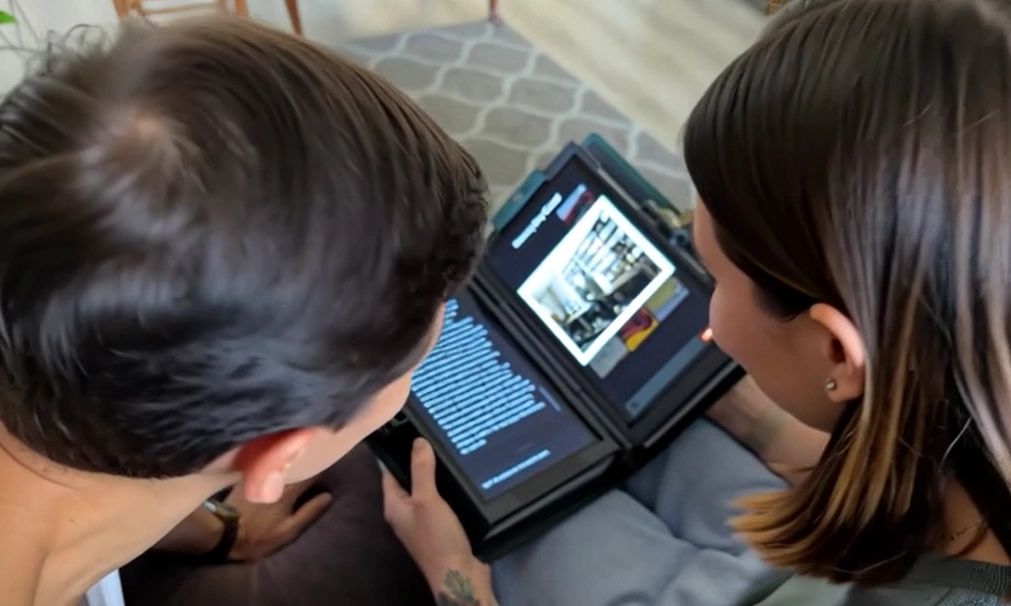
Two displays create multimodal stimulation:
- Right screen: personal photos, music, or videos
- Left screen: real-time transcription of spoken memories
This mirrors evidence-based reminiscence therapy and helps restore narrative confidence.
3. Real Emotional Responsiveness
Providing the feeling of being heard.
The system responds with empathetic cues:
- “That sounds like a special day.”
- “You always smile when you talk about your sister.
These short acknowledgments increase trust and emotional stability, even in reduced cognition.
4. Persistent Biographical Memory
Anchoring identity when it begins to drift.
The system builds and uses a structured biography, allowing conversations like:
“Do you want to continue your story about your 1965 Mustang?”
Identity continuity is one of the strongest protectors against emotional decline in early dementia.
5. A Familiar Form Factor
A book, not a device.
A leather-bound, tactile object—warm, non-technical, safe.
Older adults engage longer with familiar metaphors than digital screens or robots.
By hiding the technology, you reveal the person.
Reversing the Loneliness–Dementia Cycle
Every component of the system is designed to interrupt the cycle:
Dementia Challenge VOR Intervention Early withdrawal Gentle, effortless micro-interactions Growing isolation Daily companionship & reminiscence Isolation accelerates decline Emotional responsiveness & identity cues Identity fragmentation Persistent biography & reinforced self-schema Fear of devices Familiar, book-like form
This is connection as therapy.
Connection as neuroscience.
Connection as medicine.
Meaningful Outcomes in 8–12 Weeks
Based on the research we think this is posssible.
- ↓ Loneliness 15–20%
- ↓ Depression 10%
- ↑ Engagement 30%
- Stable or improved orientation
- ↓ Caregiver burden
These outcomes match or surpass those from the strongest social robot and reminiscence therapy studies.
But the deeper outcome is something you can’t score:
A person who feels seen again.
A family that hears stories again.
A life that reconnects with itself.
Why Voice of Reason Exists
There are millions of older adults sitting alone, wanting connection they can no longer reach for.
There are families watching someone they love speak less, smile less, and slowly recede.
Real social connection is not a wellness metric.
It is not a “nice feature.”
It is the fourth pillar of brain health.
And for the people who can’t maintain it,
we must build something that can.
That is what Voice of Reason AI is doing—
one story, one memory, one human moment at a time.