I watched a video recently that stopped me for a simple reason.
It wasn't really about technology.
It was about connection.
We live in a world with more communication than any generation in history.
Messages arrive all day.
Videos never stop.
News is continuous.
Entertainment is continuous.
Advertising is continuous.
Artificial intelligence increasingly answers us instantly.
Yet somehow many people seem to be spending less time in the kind of conversation human beings have depended upon for thousands of years.
Sitting together.
Listening.
Remembering.
Being needed.
Being known.
And increasingly, the research suggests that losing those things is not merely unpleasant.
It may be dangerous.
Loneliness and isolation are not the same thing
One of the most important distinctions in the research is between loneliness and social isolation.
Social isolation is objective. How many people do you actually interact with? How often do family or friends visit? Do you participate in social activities?
Loneliness is subjective. Do those relationships feel sufficient? Do you have someone you can confide in? Do you feel connected?
A person can live alone and not feel lonely.
Another person can be surrounded by people and feel profoundly alone.
That distinction is important because the solutions may be different.
A major 2026 Nature Communications study followed data from 277,489 UK Biobank participants and found that both loneliness and social isolation were associated with fewer years of life free from major disease. The relationship was particularly strong for years lived free of depression and anxiety. Among people experiencing both loneliness and social isolation, estimated years free of those mental disorders were substantially lower than among people experiencing neither.
The authors are careful—and we should be too. This is observational research. It does not prove that loneliness directly caused those diseases.
But it makes it very difficult to dismiss human connection as merely a lifestyle preference.
Connection is increasingly looking like part of health.
The effects may reach surprisingly far
Research has associated loneliness and social isolation with cognitive decline, dementia risk, depression, anxiety, cardiovascular disease, hospitalization, and mortality. A recent review of cognitive health concluded that social connectedness is important to cognitive function in later life and that both isolation and loneliness are significant public-health concerns in aging.
More recent mechanistic research is also exploring why.
A 2026 systematic review found associations between social disconnection and several possible pathways involved in cognitive decline: inflammation, stress-system activity, brain structural differences, sleep disturbance, depressive symptoms, reduced social and leisure engagement, and other biological-aging mechanisms. Some studies have linked greater isolation with smaller hippocampal volume and greater hippocampal atrophy, although the causal pathways remain unsettled.
That is more accurate than saying loneliness simply causes the brain to "decay."
But the direction should concern us.
The brain appears to care whether we remain connected to other people.
Isolation can become a cycle
The problem may extend beyond aging and dementia.
Recent research among adults over 50 found an association between substance use and greater loneliness. Another qualitative study of older adults using stimulants described something even more troubling: grief and loss deepened isolation; some participants used drugs to cope with loneliness; substance use and stigma then further damaged relationships, creating a cycle that became increasingly difficult to escape.
Again, that does not mean loneliness causes addiction.
Human behavior is much more complicated than that.
But it reinforces something we probably already understand intuitively.
When meaningful human relationships disappear, people often find substitutes.
Some substitutes are relatively harmless.
Some aren't.
Then we conducted a massive social experiment
I still wonder what the long-term consequences of the pandemic years will ultimately turn out to be.
For many older people, the lockdown period meant months of dramatically reduced physical contact.
Family visits disappeared.
Church disappeared.
Restaurants disappeared.
Volunteer work disappeared.
The casual conversations that structure everyday life disappeared.
Some of that damage is measurable.
Longitudinal studies have found pandemic-era deterioration in mental well-being among older adults. One recent study in Shanghai also reported accelerated cognitive decline and brain structural changes across the pandemic period, particularly among people who already had biological or health vulnerabilities. It would be wrong to attribute all of those changes specifically to lockdowns—the pandemic combined infection, stress, medical disruption, bereavement, reduced activity, and isolation—but the findings deserve attention.
So I think it is reasonable to ask:
How much damage did prolonged disconnection do?
But there is another question that interests me even more.
Can some of it be repaired?
There is reason for hope
My instinct has long been that reconnection should matter.
Increasingly, there is evidence supporting that instinct.
A 2026 randomized clinical trial involving more than 1,100 older adults found that brief telephone-delivered behavioral-activation and mindfulness interventions reduced loneliness over 12 months. Importantly, reduced social isolation partially explained some of the improvement.
A 2025 meta-analysis of videoconference interventions involving more than 1,000 older adults found improvements in social support and reductions in loneliness and depressive symptoms. Family interaction was specifically identified as an important component for reducing loneliness.
A recent umbrella review examining 28 reviews concluded that interventions can improve well-being among socially disconnected older adults, particularly when psychosocial approaches are combined with technology or structured activities and are designed to foster meaningful relationships rather than merely increase contact.
And a review of post-pandemic interventions found something especially relevant: approaches combining human and technological components appeared more promising than technology alone.
That may be the most important lesson.
Technology by itself is not connection.
Technology can create the conditions for connection.
Those are very different things.
We should not build AI to replace people
This has changed the way I think about AI companionship.
Most AI products are naturally optimized around engagement.
How many minutes did the user spend talking to the system?
How often did they return?
How many conversations occurred?
Those are understandable product metrics.
But they may be the wrong ultimate objective for a companion designed for someone who is isolated.
If an older man spends six hours talking to an artificial intelligence because nobody else calls him, have we solved loneliness?
Or have we created a very sophisticated substitute for the thing he actually needed?
At Legavo, we increasingly think the best AI companion should sometimes do something very unusual.
It should help another human being enter the conversation—and then get out of the way.
That is the idea behind the Connection Bridge we are developing.
Our current website describes Companion as a familiar, book-like device designed around conversation, personal context, photographs, reminders, and dignity, while Caregiver gives family a way to send messages, reminders, and photographs from a phone or computer.
Our recent work takes that idea further.
Imagine Dad is alone in the kitchen
Dad is 81.
His wife died several years ago.
His children love him, but they have families and jobs of their own.
Dad still lives independently.
He wants it that way.
A Legavo Companion sits on the kitchen counter.
His daughter has sent a reminder about his dentist appointment.
His son has sent a photograph of the grandchildren at a soccer game.
Dad looks at the photograph.
"She's getting tall."
The system already understands who she is.
It knows who her father is.
And through the Adaptive Reminiscence work we are developing, it can begin learning which people, photographs, places, and stories tend to create meaningful engagement.
So perhaps it says:
"You used to take Michael to baseball games when he was about that age, didn't you?"
Dad starts talking.
That memory may become part of his memoir.
And that matters for two reasons.
First, the story is preserved for the family.
Second, the story teaches the system more about Dad.
Who mattered?
What experiences shaped him?
What memories connect him to which people?
Our earlier writing called this the "third voice at the table"—not a machine replacing family conversation, but something capable of finding the photograph, memory, or question that helps two people find each other again.
Then comes the important part.
Instead of asking another question simply to keep Dad talking to the AI, Legavo might say:
"Would you like me to let Michael know you were thinking about him?"
Dad says yes.
Now AI has done something fundamentally different.
It has become a bridge.
The family is still part of the system
Michael may be hundreds of miles away.
But through Caregiver he can still participate.
He might receive a message on his phone.
He could send another photograph.
He could record a short voice message.
Dad hears Michael's actual voice.
Dad replies simply by speaking.
If both have time, the interaction can eventually become a live audio conversation.
Later, perhaps video.
The progression is simple:
Message → Photograph → Voice → Reply → Live Conversation
Dad should not have to understand Zoom.
He shouldn't have to search through contacts.
He shouldn't have to remember another password.
The technology should remove the wall between Dad and his family rather than creating another one.
And when Michael and Dad begin talking?
The AI should become quiet.
That is success.
A family conversation, made simpler
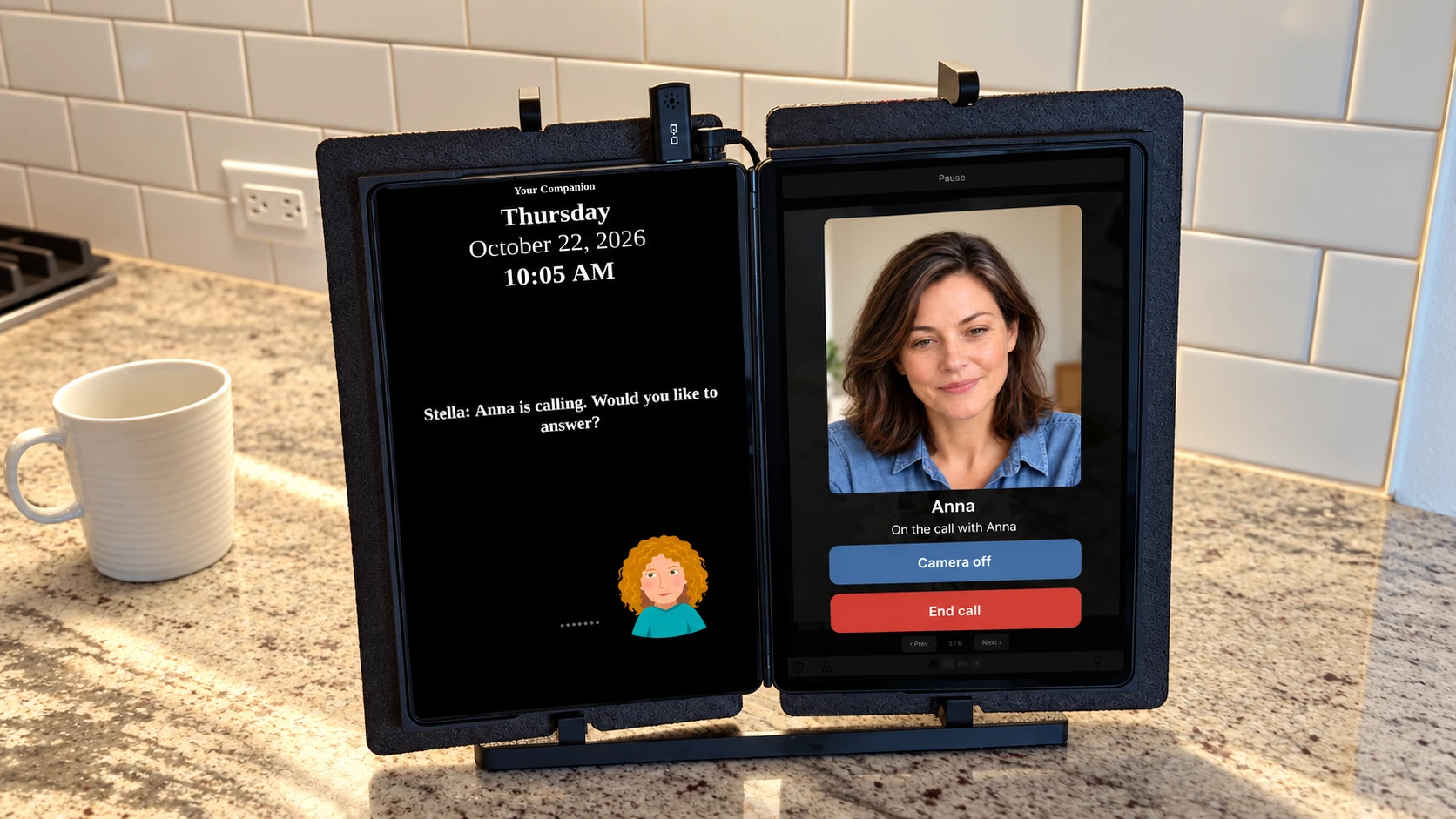
In this illustrative scene, Anna calls her mother Helen through Caregiver. Stella is the Companion’s AI voice.
Read the transcript
Anna: I will call Mom now and see how she is doing.
Stella: Anna is calling. Would you like to answer?
Helen: Yes.
Anna: I want to bring you this wonderful orchid I found!
Helen: There’s always room for one more.
Adaptive Reminiscence becomes Adaptive Connection
We have already been thinking deeply about adaptive reminiscence.
The basic question is:
What is a meaningful and safe memory cue for this particular person right now?
But Connection Bridge allows us to ask a much more interesting question:
Can this moment help create a meaningful human connection?
Maybe photographs of Emily often lead Dad to talk about Michael.
Maybe certain stories make him want to call his brother.
Maybe Sunday afternoon tends to be a good time for longer conversations.
Maybe some topics are better explored privately.
Maybe others become richer when a particular family member participates.
Over time, the system may begin to understand these patterns.
Not so that it can manipulate people into calling.
And certainly not so it can silently diagnose loneliness and report that diagnosis to family.
The person must remain in control.
The AI can recognize an opportunity.
It can offer.
It can simplify.
But the human decides.
That principle is central to how we are thinking about the next generation of Companion.
Connection should happen at the right moment
This may be where AI can contribute something genuinely new.
Families often want to help.
But timing is hard.
The daughter calls while Dad is tired.
Dad wants to talk while the son is in a meeting.
A caregiver visits and has no idea what to talk about.
A grandchild wants a relationship but does not know how to start one.
AI can potentially help coordinate those moments.
Not merely by scheduling them.
By understanding context.
Dad has just spent ten minutes talking about Michael.
That may be a good moment to invite Michael into the conversation.
A photograph has triggered a story.
That may be the right moment to preserve it.
A visitor has arrived.
That may be the time to surface a familiar photograph that gives everyone something easy to discuss.
The intelligence isn't simply in knowing what to say.
It is in knowing what should happen next.
There are no technology walls in real relationships
One reason we continue to build a dedicated Companion rather than simply another phone application is that interfaces become barriers.
Especially when memory or executive function is changing.
A person should not need to remember:
Which app?
Which password?
Which menu?
Which contact?
Which button?
The system should live quietly where life already happens.
On the kitchen counter.
Beside the chair in the living room.
Available when wanted.
Invisible when not.
Our website describes this as technology that "starts with the person," and that is exactly the principle.
AI should adapt to the human.
Not demand that the human adapt to the AI.
Maybe the pandemic taught us the wrong lesson
During the pandemic we became extraordinarily good at replacing physical interaction with digital interaction.
Zoom.
Social media.
Streaming.
Messaging.
Everything came through a screen.
And those technologies were invaluable.
But perhaps we confused communication with connection.
That distinction matters.
One post-pandemic study found that several dimensions of psychological well-being among older people eventually recovered and in some cases exceeded pre-pandemic levels, although depressive symptoms remained above their earlier baseline.
That tells me something encouraging.
Human beings are resilient.
Damage is not always destiny.
But resilience often requires conditions in which recovery can occur.
Relationships.
Purpose.
Activity.
Conversation.
Belonging.
So I would not say the harm caused by isolation can simply be erased.
Science cannot support that.
But I think we can say something more useful:
People can reconnect.
Loneliness can improve.
Social networks can expand again.
Well-being can recover.
And technology can help—particularly when technology leads back toward actual people rather than becoming the permanent substitute for them.
This is not just an aging problem
Everything I have described matters enormously for older adults.
But I suspect the broader principle applies to all of us.
We have more input than ever.
More content.
More entertainment.
More information.
More artificial conversation.
More opportunities to avoid silence.
Yet perhaps fewer opportunities to be deeply known.
Isolation can affect the elderly person sitting alone in a house.
It can affect the teenager scrolling through thousands of people.
It can affect the widower who stops going out.
It can affect someone coping with addiction.
It can affect the caregiver whose entire social life has gradually disappeared into caregiving.
The solution will not be one device.
It will not be one piece of software.
It will not be AI alone.
It will be finding ways to rebuild the connections human beings need.
The goal is not more AI
This is the principle I keep coming back to.
I don't want Legavo to succeed because someone spends six hours talking to our AI.
Maybe Companion talks with Dad for twenty minutes.
Maybe it reminds him about an appointment.
Maybe it shows him three photographs.
Maybe it helps him remember a story nobody has heard before.
Maybe it preserves that story.
And maybe it creates one ten-minute conversation with his son.
That might be an extraordinary day.
AI was there when nobody else was.
And when another human being could be there, AI helped make that happen.
That is the distinction.
We are not trying to build artificial relationships good enough to replace human ones.
We are trying to build technology intelligent enough to strengthen the human relationships that already give life meaning.
The technology should never become the relationship.
It should help the relationship happen.
And perhaps, after years in which the world became increasingly good at keeping us entertained, informed, and digitally occupied while physically apart, helping people find one another again may be one of the most worthwhile things artificial intelligence can do.