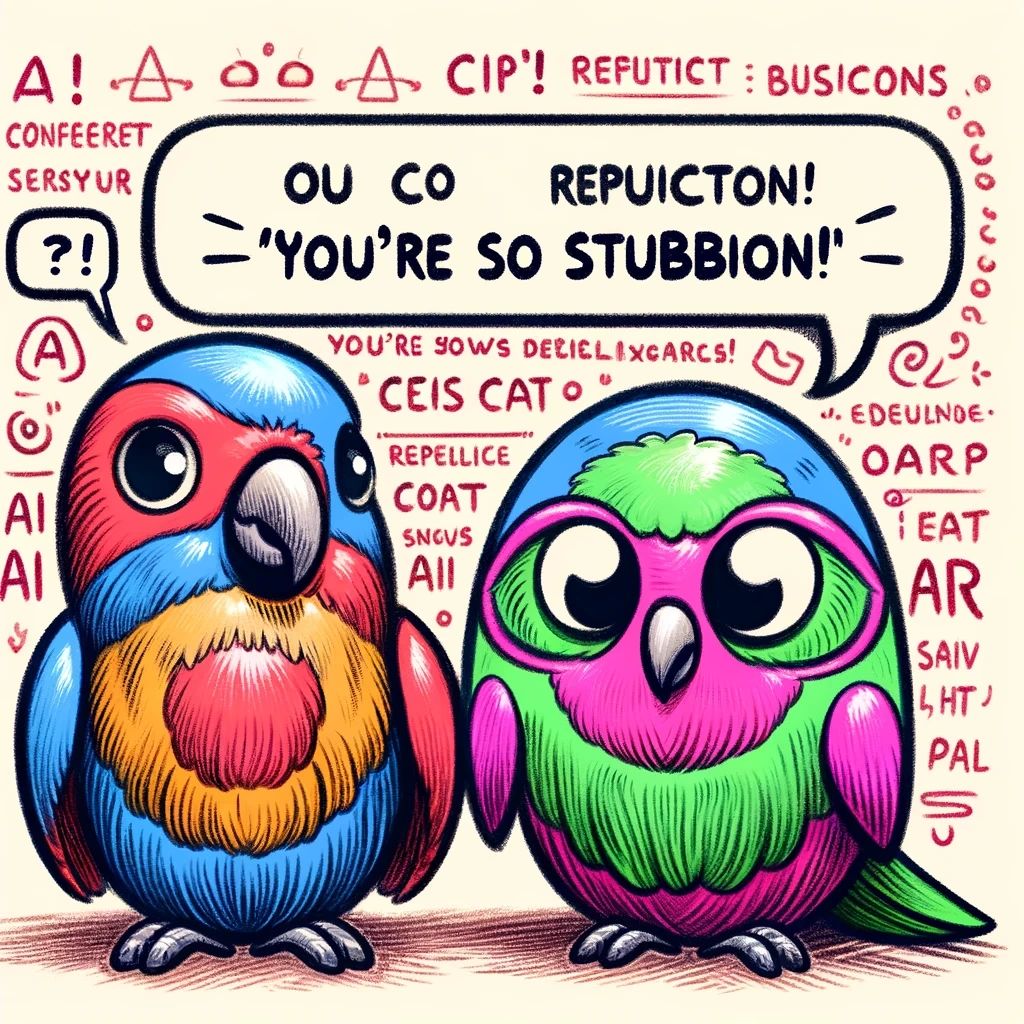
Remember when you were a kid, and you wanted to bug your sibling? A surefire way to do it was to repeat back everything they said: “You’re so stubborn!” – “No, you’re so stubborn!” This usually went on until either someone got frustrated, a little skirmish broke out, or someone finally walked away. While this might have been funny as a kid, having an AI do the same thing feels odd and artificial, breaking the flow of the interaction.
Why does this feel so unnatural in an AI? Unlike people, AIs don’t have emotional context, intent, or a sense of humor. When a human mirrors back your words, it’s often for a reason: they might be teasing you, trying to clarify, or even challenging you. In contrast, when an AI simply reflects what’s already been said, it can feel like a glitch or a lack of understanding – a kind of conversational dead end. We expect AIs, especially those assisting with memory or social engagement, to support and enhance communication, not to mirror us back in a way that feels like a conversation with ourselves.
For people relying on AI for memory support or social guidance, this lack of flow disrupts the experience. Imagine using AI as a conversational aid, where it should help bridge memory gaps or keep the conversation dynamic, yet it repeats simple phrases or returns to previous topics without adding value. In these cases, the interaction can feel stagnant, undermining the purpose of the technology. This is especially frustrating for someone who might rely on the AI to track essential details or keep conversations fresh.
Let’s look at why AIs fall into these repetitive patterns and how we can guide them toward more natural interactions.
1. Avoid Repetitive or Minimal Input
When the input lacks variety or new information, the AI has little to build on. It’s like chatting with a friend who only says, “I went hiking,” without elaborating. After a while, the AI defaults to simply reflecting what’s already there, which feels like a loop.
- Tip: Encourage the AI to summarize or build on past interactions instead of simply mirroring them. For example, it could respond with, “John interacted with Speaker 1 again, like last time,” subtly acknowledging routine without outright repeating the same response. This gives the conversation a bit of movement rather than getting stuck on a single note.
2. Loosen Up on What Counts as Important
Often, an AI is programmed to focus on major events, and anything considered “minor” gets filtered out. This approach can result in silence or repetitive output if nothing significant occurs. Imagine if a friend only wanted to hear about major life changes – like a new job or a big move – and ignored smaller but interesting details like a weekend outing or a chat with a neighbor. The little details add richness and make the conversation feel alive.
- Tip: Give the AI permission to acknowledge smaller interactions or minor updates. Even noting a “routine check-in” adds subtle variety. The AI could say, “John chatted with Speaker 1 about everyday things,” keeping the conversation dynamic without overloading it with trivial details.
3. Handle Minimal Event Updates Gracefully
Sometimes the AI’s criteria for “significant events” are so strict that nothing qualifies, causing it to fall back on recent dialogue, resulting in redundant output. This is like answering “What’s new?” with “Nothing much” every time – it stalls the interaction.
- Tip: If there’s nothing significant to add, the AI can simply acknowledge this with, “No major updates; routine conversation only.” This is like telling your friend, “Just the usual weekend stuff,” which keeps things concise but prevents looping on old topics.
4. Switch Up Language to Avoid Loops
Repetition of phrasing can make an AI sound stale, especially when the same conversations occur often. It’s like telling your hiking story with the exact same words every time – it starts to sound rehearsed, even robotic.
- Tip: Encourage slight variations in the AI’s language. For instance, instead of saying, “Speaker 1 visited John” every time, the AI could alternate with, “John chatted with Speaker 1 today.” Small tweaks in phrasing go a long way in making the AI sound more natural and less robotic.
Technical Example: Using Summaries and Contextual Filters
Let’s bring this to life with a practical example. Imagine an AI assistant designed to help John, a person with Alzheimer’s, remember details about his family. The AI tracks significant events like family visits and important milestones, but ignores minor updates like small talk or routine greetings to keep memory organized.
Now, let’s say John’s family members frequently visit and open with familiar lines like, “Hi, John! How are you today?” Without careful design, the AI might start mirroring these greetings back or repeating past interactions because it interprets these phrases as repetitive.
Here’s where technical adjustments can make all the difference:
-
Contextual Filter for Minor Interactions:
- Tag routine phrases like “Hi, John” as “routine interaction markers.” This tells the AI that while it’s listening to the conversation, it doesn’t need to record these phrases as new information. Instead, it focuses on any unique information that follows, such as if a family member mentions a recent event like, “We took Emily to the zoo yesterday!”
-
Summarization Strategy for Routine Conversations:
- Rather than reflecting each greeting back, implement a summarization strategy that generates a response like, “Family check-in completed; no new updates,” when interactions are routine. Alternatively, if something important is mentioned, it can add that specific detail, such as “Routine greeting followed by a mention of Emily’s zoo visit.”
-
Dynamic Language Variability:
- To avoid identical responses, build in language variability. For instance, instead of outputting, “Michael visited John today,” each time, the AI could use phrasing alternatives like, “John had a quick chat with Michael.” This keeps responses fresh and engaging.
Why It Matters
When an AI reflects the same content back, users start to feel like they’re talking to a system that doesn’t understand context or novelty. In human conversations, we rely on subtle changes in expression, tone, and language to communicate that we’re engaged and paying attention. A good conversation feels like it has rhythm – it flows, has variations, and moves forward. When AI gets stuck in repetitive loops, that rhythm breaks, leaving users with a sense that they’re not understood, and the interaction feels more like operating a machine than having a conversation.
Making AI a More Engaging Partner
By applying these strategies, we can help AI feel more responsive and natural. The AI will be able to build on what’s been said, adding new layers of meaning and avoiding that stale, repetitive feel. Ultimately, we’re creating a better conversational partner – one that feels alive and engaged, rather than a static mirror reflecting back only what it sees.