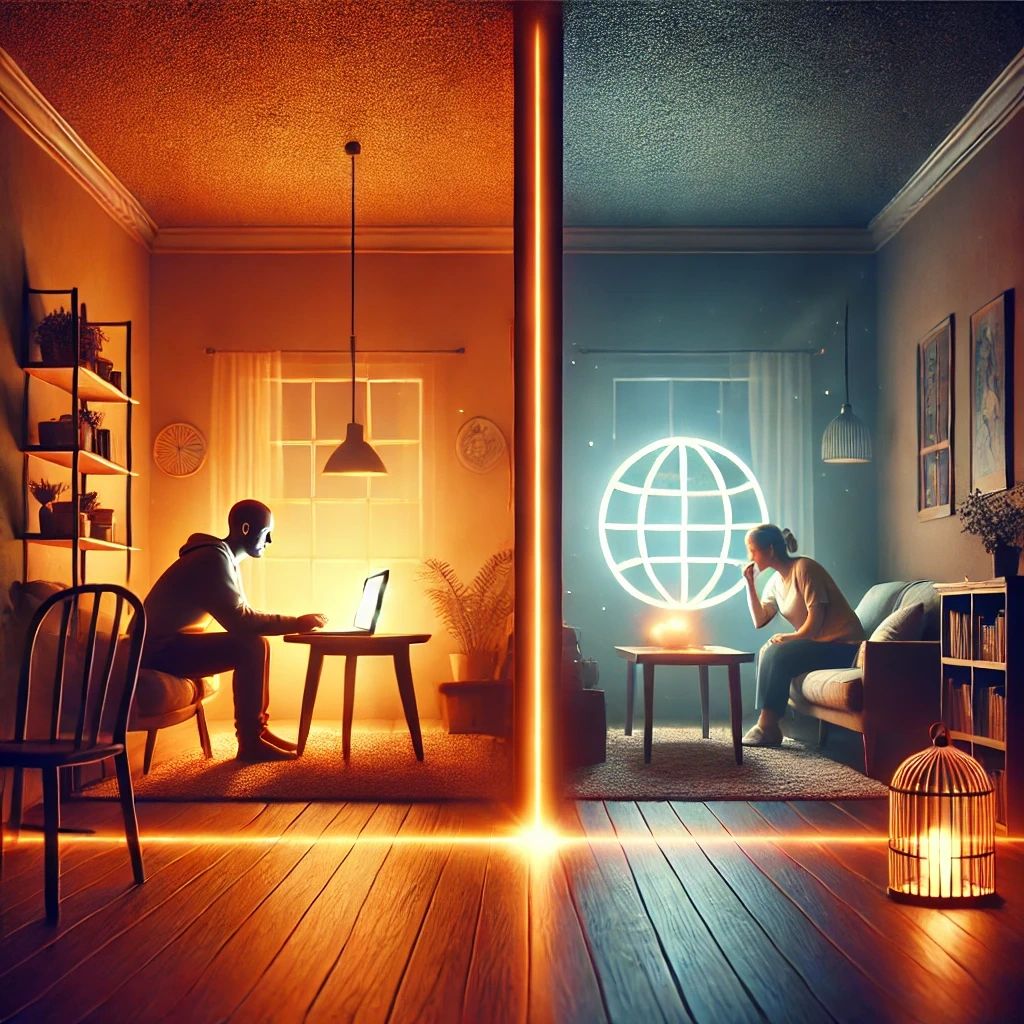
The data on human interaction paints a stark picture: in a typical day, only 6.5% of our time is spent in face-to-face connection. Yet these fleeting moments are critical—not only for maintaining social bonds but also for nurturing our emotional and cognitive health. For individuals facing memory challenges, these interactions hold even greater significance, serving as lifelines to identity, relationships, and a sense of belonging.
At Voice of Reason AI, we recognize this delicate balance. As a society, we must strive to rebalance the scales, ensuring that our increasing reliance on machines doesn’t come at the cost of our humanity. Technology, while offering immense convenience, should amplify our ability to connect rather than diminish it.
This belief is at the heart of what we do. By combining the power of artificial intelligence with a deep respect for human connection, we’re creating solutions like the VOR Oracle system—tools designed to enhance life’s most meaningful interactions. These technologies are more than devices; they are bridges, enabling individuals with memory challenges to live more fully and connect more deeply—with others, with themselves, and with the moments that make life beautiful.
Our mission is clear: to empower people with memory challenges to live with dignity, autonomy, and joy. Together, we can ensure that technology serves humanity, reminding us all of the irreplaceable value of real, human connection.
In today’s world, dominated by screens and digital connectivity, it’s startling to realize just how little time we spend connecting face-to-face with one another. The decline of in-person interaction has become a quiet, unnoticed shift in our daily lives, replaced by the hum of machines and the glow of devices. But what does this really look like when we break down a typical day? Let’s take a closer, more personal look at how our time is spent and what it means for our well-being and relationships.
We start with the basics—sleep. On average, adults spend about a third of their day, or roughly eight hours, asleep. It’s a non-negotiable slice of time that ensures our survival and well-being but leaves us with just two-thirds of the day to work, play, and connect.
The next significant block of time is dedicated to work and commuting. A typical full-time worker spends about 8.5 hours working and an additional hour commuting. And yet, despite the sheer amount of time we spend in professional settings, only about an hour of this time involves direct, face-to-face communication, such as meetings or casual conversations with colleagues. That’s less than 5% of the day.
Then there’s screen time—a defining feature of modern life. Studies show the average person spends a staggering seven hours daily on devices. Whether it’s scrolling through social media, streaming shows, or responding to messages, these interactions are primarily with machines, not people.
After accounting for these major activities, we’re left with just a handful of hours—roughly 5.5—dedicated to everything else: eating, errands, personal care, and leisure. Yet even here, only about 34 minutes of that time is typically spent in face-to-face communication with family or friends.
When all is said and done, the numbers are sobering. Out of a full 24-hour day, the average person spends just 1.57 hours, or about 6.5% of their day, engaging in real, human-to-human interaction. It’s a shocking statistic that reveals how much our lives have shifted away from connection toward isolation, even as we’re busier than ever.
What Does This Mean for Us as Individuals and as a Society?
The lack of face-to-face interaction has profound implications for our emotional health. Social skills and emotional intelligence, essential for building relationships and navigating life’s complexities, suffer when they aren’t exercised. Research links this imbalance to feelings of loneliness, anxiety, and depression.
We’ve also seen cultural shifts, particularly among younger generations, where “socializing” increasingly means virtual interactions rather than in-person connections. This redefinition of relationships could fundamentally alter how societies function and bond.
And yet, this shift toward machine-mediated interaction isn’t entirely negative. Technology has provided incredible convenience, allowing us to connect globally and access knowledge instantly. The pandemic underscored this duality—technology became a lifeline when face-to-face interaction was limited, but it also reminded us of the irreplaceable value of in-person contact. The warmth of a hug, the nuance of a smile, and the comfort of being physically present with someone simply can’t be replicated through a screen.
Restoring Balance
So, what can we do to restore balance? It begins with intentionality. We must consciously carve out time for face-to-face connections in our personal and professional lives. Limiting screen time and embracing digital detox practices can help us reclaim those moments of genuine interaction. Designing urban spaces, workplaces, and communities that prioritize human connection can create environments where these interactions thrive.
The challenge is clear, but so is the opportunity. By taking deliberate steps to nurture human connection, we ensure that as technology continues to evolve, we don’t lose sight of what makes us truly human: the ability to connect, share, and build relationships deeply and authentically. The choice is ours to make, and the time to act is now.