At Voice of Reason AI, we are always pushing the boundaries of technology and design to support people with brain disorders, like Alzheimer’s, in improving their autonomy and social interactions. Recently, we’ve been working on a cutting-edge architecture, and we’d like to share its current state, the advantages it offers, and some of the challenges we’re tackling.
The Architecture We’re Building
Our architecture involves several parallel processing elements to create a system that can actively listen to conversations, pull up relevant facts from a user’s memory file, and provide real-time, context-aware hints. This system involves multiple Hint Generators, Fact Management, a RAG Retrieval system (Retrieval-Augmented Generation), and other components like Mid-Memory, Biography, and Context Files to ensure timely and personalized responses.
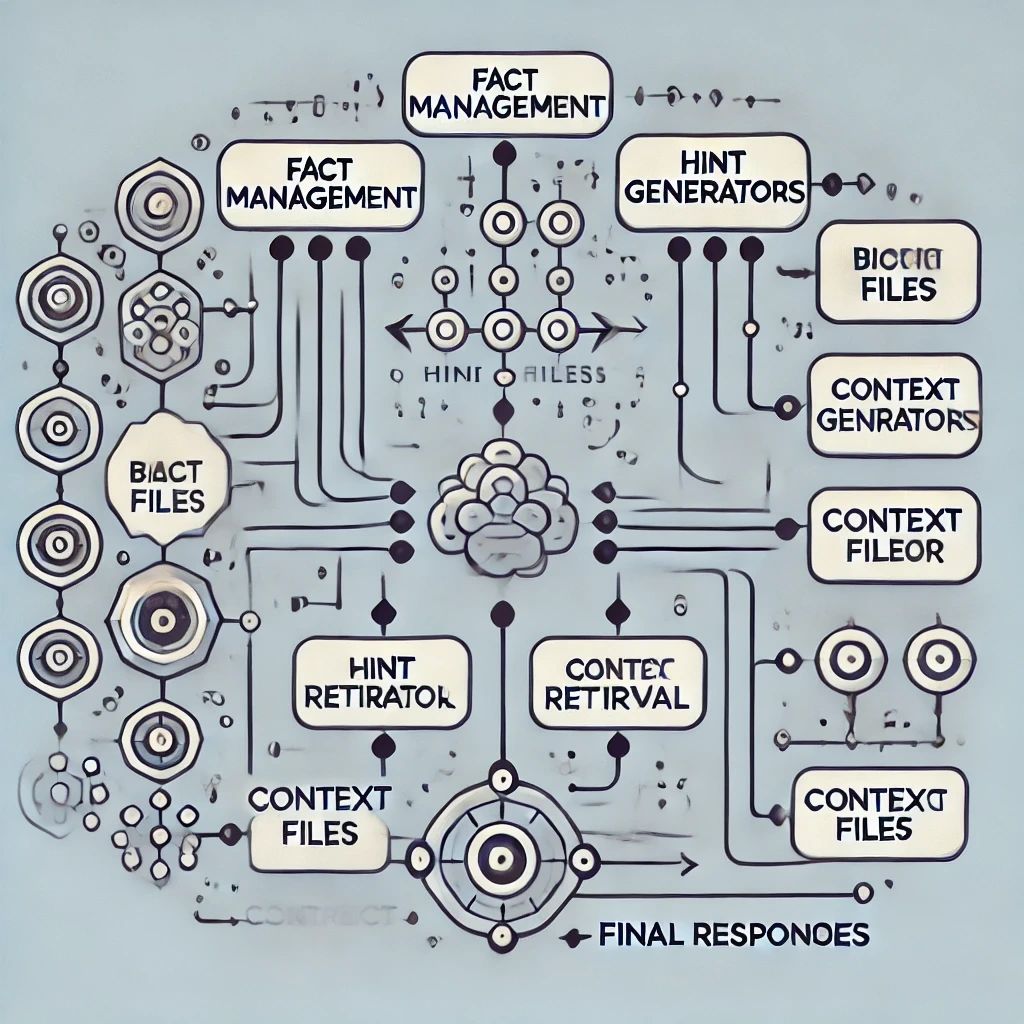
Here’s a high-level diagram of the architecture we’re working on:
The diagram visualizes how we manage inputs from conversations, update context and biography files, and combine the outputs of parallel Hint Generators to deliver relevant memory-based hints. The architecture is dynamic, allowing it to adapt to ongoing interactions, while leveraging a RAG-based system to retrieve vital information quickly and effectively.
The Power of AI-Generated Diagrams and Code
One of the greatest advantages in our development process has been leveraging AI to assist with the design and creation of diagrams directly from meeting notes. During our brainstorming and architecture discussions, we found that manually creating diagrams was slowing down our iterations. This is where AI stepped in to act as both a design reviewer and concept sounding board.
Using AI tools, we transformed meeting notes into complex architectural diagrams like the one you see above. The AI also helps us generate initial code snippets based on these diagrams, making our development process far more efficient. This combination of text-to-diagram-to-code has become an integral part of our workflow, allowing us to iterate quickly and stay focused on building solutions rather than getting bogged down in low-level tasks.
The Pros of This Architecture
- Parallel Processing for Efficiency: The use of multiple hint generators allows us to process user input faster, ensuring that hints are delivered promptly and contextually relevant to the conversation.
- Dynamic Context Updates: The system continuously updates context files and fact management, ensuring that the hints provided are both timely and personalized. This means the system can improve over time by learning from ongoing interactions.
- RAG-Based Retrieval: The RAG system integrates user biography and context, allowing us to pull up relevant facts from the user's history quickly. This retrieval system ensures the accuracy of the information provided, crucial for users with memory disorders.
The Challenges and Considerations
- Complexity: While the architecture is powerful, managing multiple LLMs (Large Language Models) in parallel comes with complexity. Synchronizing the data flow between the biography file, mid-memory, and context file requires careful management to avoid delays or inconsistencies.
- Resource Intensive: The architecture, especially with real-time updates and parallel processing, demands significant resources. This poses a challenge in scaling the system for widespread use without compromising on performance.
The Future of AI-Assisted Design
The impact of AI-assisted design has been undeniable for us at Voice of Reason AI. Beyond generating diagrams and code, AI has become a crucial tool for design review. As we present new ideas, AI models evaluate these concepts, helping us find weaknesses early on. We’re no longer designing in isolation; AI is an active participant in our development process.
We believe that as we continue to refine this architecture, we will further streamline the process of developing cutting-edge, AI-based memory aids for individuals with brain disorders. Using AI as both a design tool and a collaborator has accelerated our work, and we’re excited to continue exploring new ways to integrate these technologies.
Stay tuned for more updates as we push the boundaries of AI and architecture to improve lives. Check out our latest developments at Voice of Reason AI.
Conclusion
AI has transformed the way we think about and implement our designs. From text-to-diagram capabilities to real-time code generation, our architecture is becoming a living blueprint that evolves with every iteration. As we continue to explore how AI can assist in development, we’re confident that this technology will help us achieve new milestones in supporting users with memory disorders.
Let’s keep building, together.