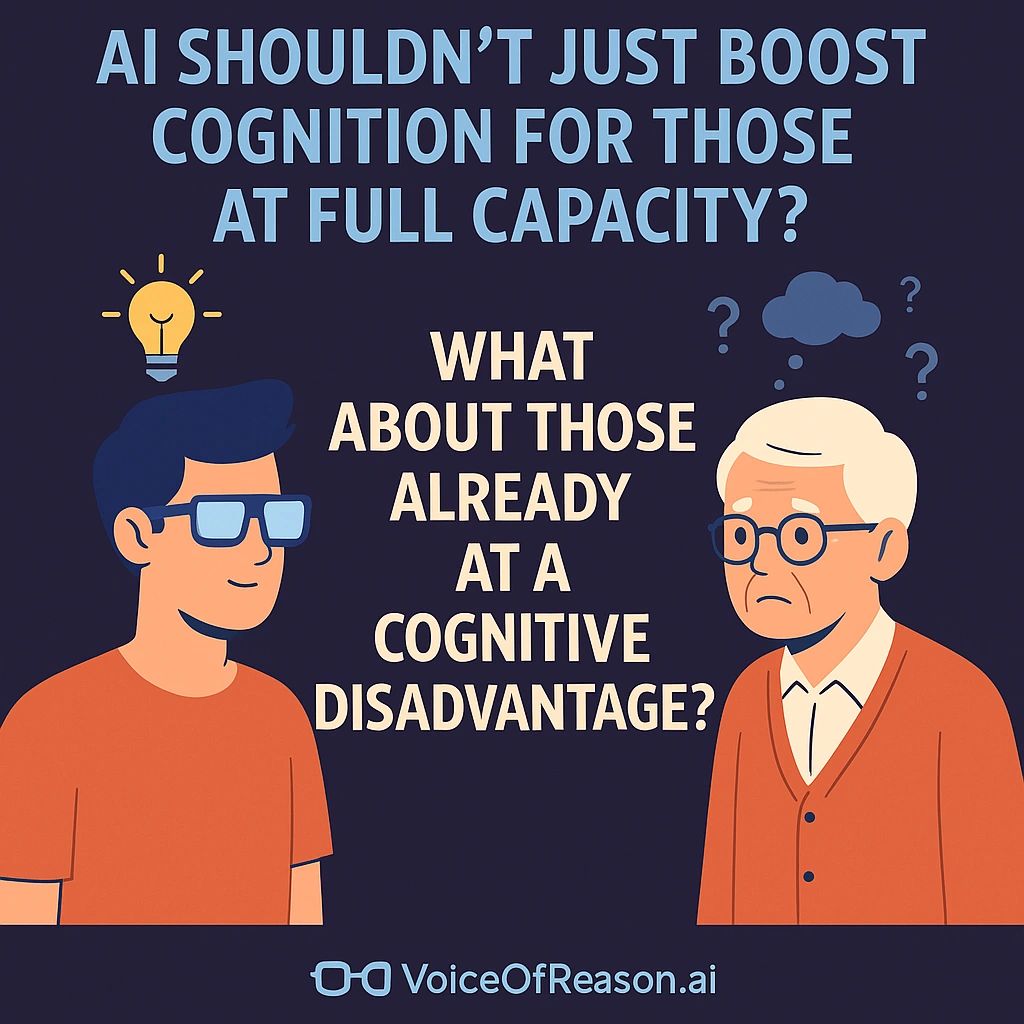
Why AI Glasses Shouldn't Just Be for the Future: Empowering Cognitive Independence Today
“I think in the future, if you don’t have glasses that have AI or some way to interact with AI, I think you’re kind of similarly, probably [going to] be at a pretty significant cognitive disadvantage.”
— Mark Zuckerberg, 2024
When Mark Zuckerberg said this, he wasn’t talking about people with dementia or brain injuries. He was talking about everyone. But that’s exactly the point.
If we agree that future AI assistants will be essential to keep up cognitively — a kind of second brain — why are we not urgently building this capability for those already at a cognitive disadvantage today?
At VoiceofReason.ai, that’s precisely our mission. We are developing AI companions not just for convenience — but for cognitive empowerment. Our goal is to transform lives by helping people with Alzheimer’s, learning disabilities, or traumatic brain injury live more independently, socially connected, and with greater dignity.
A Small Cognitive Boost Makes a Big Difference
There is a stark, often overlooked, difference between someone with marginal cognitive ability and someone who requires 24/7 care. A person with an IQ of around 70–75 may be able to live semi-independently, work with assistance, and maintain relationships. Drop that IQ by just 10–15 points — to the 55–60 range — and full-time care often becomes necessary.
That’s a small numerical difference — but a massive difference in quality of life.
Now imagine if we could use AI to add back just that small margin. If we could restore the ability to recall a name, follow a routine, or engage in conversation — we could keep people independent longer, reduce caregiver burden, and delay institutionalization.
Introducing the Biograph: A Digital Memory Companion
Our first product, currently in alpha testing, is called the Biograph. It’s not smart glasses — those will come later. Instead, Biograph is something even more important: a living memory partner designed to be present, trusted, and integrated into daily life.
Biograph is not worn — it’s lived with. It’s a familiar, comforting object in the home, engaged with naturally by the person with memory loss, family members, and caregivers alike.
Here's what it does:
- 🧠 Memory Recording: It records personal stories, life events, and meaningful interactions — with timestamps and structure — preserving what might otherwise fade forever.
- 🗣️ Conversational Recall: It can share relevant memories in conversation, remind the person gently about relationships, recent events, or key details, and provide the right information at the right time.
- 👥 Caregiver Collaboration: Family and caregivers can contribute and review information, ensuring everyone is working from the same “book of memory.”
- 🤝 Social Bridge: Biograph helps users engage with visitors or acquaintances, reinforcing social connection — a key factor in slowing cognitive decline.
Biograph doesn’t replace memory — it buttresses it, reinforcing what remains, retelling what is fading, and ensuring that nothing truly important is lost.
This is the foundational layer for everything we’ll build next: future AI interfaces like glasses, ambient sensors, and health monitors will all depend on this core of personalized memory to function with emotional intelligence and context.
This Isn’t a Thought Experiment — It’s a Moral Imperative
Zuckerberg is right — AI glasses (or their wearable equivalent) will become essential for navigating a complex world. But for millions already struggling, that world is already too complex.
By giving them tools that can:
- supplement memory,
- support communication,
-
and provide gentle nudges for daily tasks,
…we’re not just building technology — we’re restoring agency.
The Future Can Be Fairer — If We Build It That Way
AI is advancing rapidly. But if we only design for the fully-abled, we’ll leave behind those who could benefit most.
At Voice of Reason, we believe the same cognitive edge that will help a knowledge worker write emails faster can help someone with early dementia remember their grandchild’s name.
The tools we’re building now — especially Biograph — are more than features. They are lifelines. Small boosts in recall and recognition can lead to:
-
More independence
-
Reduced caregiver burnout
-
And above all, a longer, richer connection with life
Help Us Build a More Compassionate Future
The “AI glasses” of tomorrow are already here. But instead of waiting for mass-market versions to trickle down, we’re starting where the need is greatest.
If you’re a caregiver, researcher, or simply someone who believes in the dignity of every mind — join us. The future doesn’t have to leave anyone behind.
Visit voiceofreason.ai to learn more, contribute, or be part of our testing community.