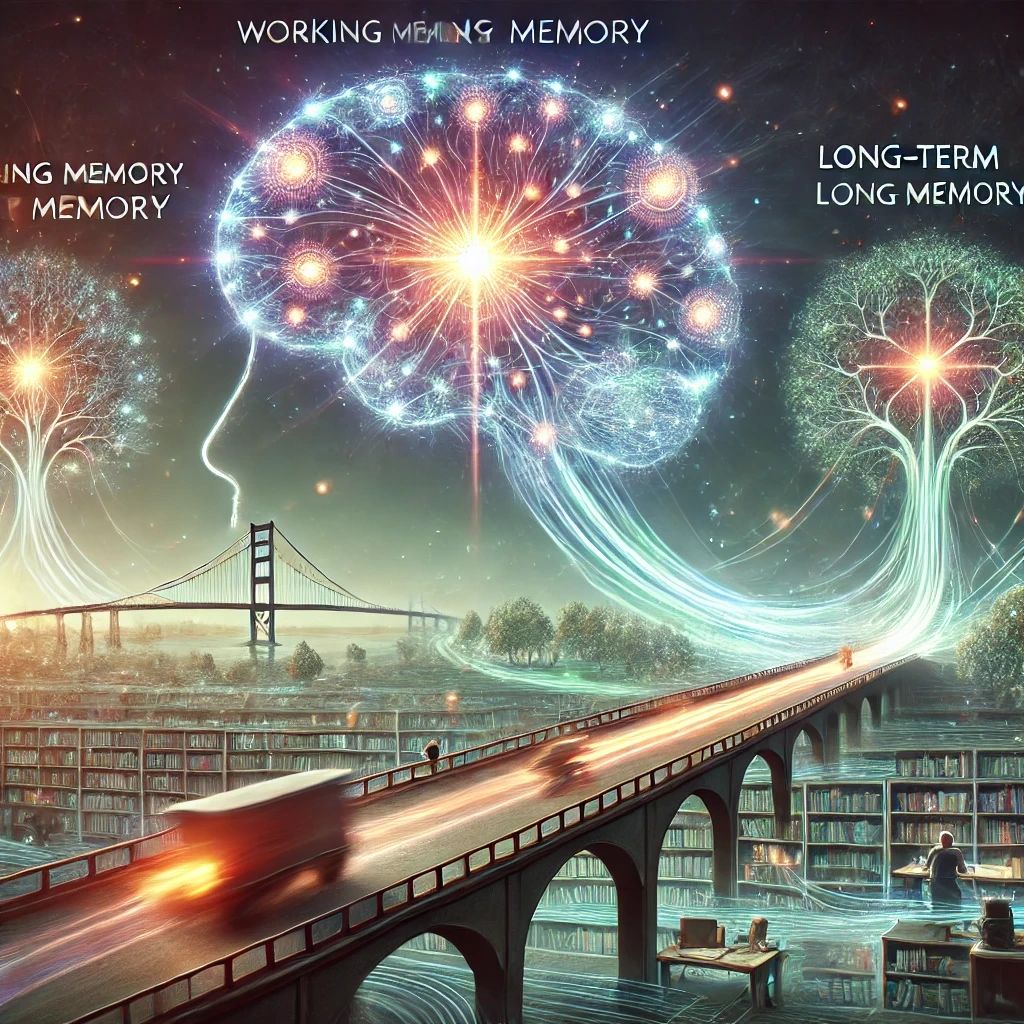
Understanding Human Memory as Inspiration
Before diving into our AI architecture, let's explore the fascinating world of human memory that inspired our design. The human brain is an incredible machine that processes memories in ways we're still working to understand. Think of it as a symphony of three distinct yet harmonious memory systems, each playing its own crucial role in our consciousness.
Working memory is our mind's immediate workspace, lasting only seconds to minutes. It's where we hold our current thoughts and manage ongoing conversations - like keeping track of what someone just said while formulating our response. Interestingly, this workspace has a rather limited capacity, typically holding only about seven pieces of information at once, give or take two. It's why remembering a phone number momentarily can be challenging, but remembering your childhood phone number might be effortless.
Then there's intermediate memory, operating over hours and weeks, acting as a bridge between our immediate thoughts and lasting memories. This is where our brain processes recent events and conversations, gradually weaving them into the fabric of our longer-term memories. It's like a mental workspace where experiences are sorted, connected, and prepared for long-term storage.
Our long-term memory, spanning years to a lifetime, is perhaps the most fascinating. It's here that our life experiences and learned knowledge reside, forming the autobiography of our existence. This system doesn't just store information; it maintains our personal narrative, shaping who we believe ourselves to be.
Studying early-stage Alzheimer's has provided profound insights into how these memory systems interact. The disease's progression reveals something remarkable: in its early stages, a person's working memory often remains surprisingly intact. They can engage in immediate conversations and handle current situations quite well. However, their intermediate memory begins to show inconsistencies, and forming new long-term memories becomes increasingly difficult. Yet, intriguingly, their older long-term memories often stay remarkably stable and accessible.
This pattern teaches us something crucial about memory system design: it's not just about storage - it's about the intricate connections between different types of memory. When someone with early Alzheimer's struggles to form new long-term memories while retaining old ones, we're seeing a breakdown in the transfer process between memory systems, not necessarily the storage systems themselves.
These insights have profoundly influenced our AI architecture. We've created parallel systems that mirror human memory: our History File functions like working memory, handling immediate context; Mid Memory serves as intermediate storage, processing recent interactions; our Dynamic Biography system acts as long-term memory, building a persistent narrative; and our RAG System works like neural pathways, retrieving and connecting memories as needed.
This biomimetic approach helps us create AI systems that don't just store information, but process and retain it in ways that feel more natural and human-like. As we explore the technical details of our architecture, you'll see how these biological insights have shaped every aspect of our design...
In the rapidly evolving landscape of conversational AI, one of the most challenging aspects is creating systems that can maintain context and learn from interactions over time. Today, I'm excited to share insights into an innovative architecture we've developed that combines multiple LLMs (Large Language Models) with a dynamic memory system, enabling AI to build and maintain an evolving understanding of ongoing conversations and relationships.
The Challenge
Traditional conversational AI systems often struggle with:
- Maintaining consistent context across long conversations
- Remembering and learning from past interactions
- Integrating new information into their knowledge base
- Managing multiple types of memory (short-term, medium-term, and long-term)
- Coordinating multiple LLMs effectively
Our solution addresses these challenges through a sophisticated multi-layered architecture that combines parallel LLM processing, dynamic memory management, and automated biography maintenance.
System Architecture Overview
Core Components
-
Triple LLM Processing Layer
- LLM1 (Primary Hint Generator): Generates responses with context awareness
- LLM2 (Fact Management): Processes and validates biographical information
- LLM3 (Secondary Hint Generator): Provides meta-analysis and feedback
-
Memory Management System
- History File: JSON-based conversation history
- Context File: Current conversation context and RAG results
- Mid Memory: Intermediate event storage
- Dynamic Biography: Long-term memory storage
-
RAG (Retrieval-Augmented Generation) System
- ChromaDB for efficient vector storage and retrieval
- Dynamic embedding updates
- Contextual search capabilities
-
Biography Update System
- Event processing pipeline
- Validation and deduplication
- Automated biography maintenance
- Real-time RAG updates
The Innovation: Dynamic Biography Updates
The most exciting aspect of this architecture is its ability to automatically update and maintain a growing biography based on ongoing conversations. Here's how it works:
1. Event Capture and Processing
pythonCopyclass EventProcessor:
    def __init__(self, max_queue_size=1000):
        self.event_queue = asyncio.Queue(maxsize=max_queue_size)
        self.event_patterns = {
            'action': r'RECENT_EVENTS:.*?(?=\n\n|$)',
            'timestamp': r'\[(\d{4}-\d{2}-\d{2}\s\d{2}:\d{2}:\d{2})\]'
        }

    async def process_mid_memory(self, mid_memory_content):
        events = self._parse_events(mid_memory_content)
        for event in events:
            await self.event_queue.put(event)
The EventProcessor continuously monitors the mid-memory system for new significant events. When detected, these events are queued for processing and validation.
2. Smart Event Validation
pythonCopyclass EventValidator:
    def __init__(self):
        self.seen_events = set()
        self.validation_rules = [
            self._check_content_length,
            self._check_content_relevance,
            self._check_uniqueness
        ]

    async def validate_event(self, event):
        return all(rule(event) for rule in self.validation_rules)
Each event undergoes rigorous validation to ensure:
- Uniqueness (preventing duplicate entries)
- Relevance (filtering out noise)
- Content quality (maintaining biographical standards)
3. Biography Management
pythonCopyclass BiographyManager:
    def __init__(self, biography_file_path):
        self.biography_file_path = biography_file_path
        self.lock = asyncio.Lock()
        self.section_markers = {
            'early_life': 'Early Life and Background',
            'career': 'Career and Achievements',
            'recent': 'Recent Events and Activities'
        }

    async def update_biography(self, new_events):
        async with self.lock:
            current_bio = await self._read_biography()
            updated_bio = await self._merge_events(current_bio, new_events)
            await self._write_biography(updated_bio)
            return updated_bio
The BiographyManager handles the complex task of integrating new events into the existing biography while maintaining narrative coherence and chronological order.
4. Dynamic RAG Updates
pythonCopyclass DynamicRAGSystem:
    def __init__(self, chroma_client, embedding_model):
        self.chroma_client = chroma_client
        self.embedding_model = embedding_model
        self.chunk_size = 500
        self.chunk_overlap = 50

    async def update_embeddings(self, biography_text):
        chunks = self._create_chunks(biography_text)
        embeddings = await self._generate_embeddings(chunks)
        await self._update_chroma(chunks, embeddings)
As the biography grows, the RAG system automatically:
- Chunks new content
- Generates embeddings
- Updates the vector database
- Maintains search efficiency
Performance and Scaling Considerations
-
Concurrent Processing
- Async/await patterns for non-blocking operations
- Queued event processing for smooth performance
- Lock-based synchronization for critical sections
-
Memory Optimization
- Efficient chunking strategies
- Incremental updates to reduce processing load
- Smart caching of frequently accessed content
-
Error Handling and Recovery
- Robust retry mechanisms
- Transaction-like updates for consistency
- Comprehensive logging and monitoring
Real-World Impact
This architecture has several practical advantages:
-
Improved Conversation Quality
- Better context awareness
- More consistent personality
- Natural conversation flow
-
Learning and Adaptation
- Continuous knowledge accumulation
- Dynamic personality development
- Improved response relevance
-
System Reliability
- Robust error handling
- Consistent state management
- Scalable performance
Implementation Considerations
When implementing this architecture, consider:
-
Data Privacy
- Implement proper event filtering
- Maintain data retention policies
- Handle sensitive information appropriately
-
Resource Management
- Balance update frequency
- Optimize embedding generation
- Manage database growth
-
Monitoring and Maintenance
- Implement comprehensive logging
- Monitor system performance
- Regular validation of biography content
Conclusion
This dynamic memory architecture represents a significant step forward in creating more intelligent and adaptable conversational AI systems. By combining multiple LLMs with sophisticated memory management and automatic biography maintenance, we've created a system that can truly learn and grow from its interactions.
The architecture's modular design allows for easy expansion and modification, while its robust error handling and performance optimizations make it suitable for production environments. As we continue to develop and refine this system, we expect to see even more impressive capabilities emerge.
Future Directions
We're actively exploring several exciting possibilities:
-
Emotional Memory
- Tracking emotional context
- Understanding relationship development
- Adapting conversation style
-
Multi-Entity Support
- Managing multiple biographies
- Understanding relationships between entities
- Handling group conversations
-
Advanced Analytics
- Conversation pattern analysis
- Personality development tracking
- Interaction quality metrics
Stay tuned for more developments as we continue to push the boundaries of what's possible in conversational AI!
This article is part of our technical series on advanced conversational AI architectures. For more information, visit voiceofreason.ai