Why It’s Hard, Why It Matters, and What We Can Learn from Human Memory and mem0-Style Systems.
By Richard Counts
Artificial intelligence keeps surprising us. It can hold conversations, recognize images, generate stories, and even adjust its tone to comfort someone who is upset. Yet despite these advances, one capability continues to sit at the very edge of what modern AI can reliably deliver—a capability that becomes absolutely essential the moment AI steps into the world of caregiving and cognitive assistance:
Memory.
For Voice of Reason’s Companion—our AI designed to support individuals living with dementia, traumatic brain injuries, and learning disabilities—memory is not a luxury or a future upgrade. It is the foundation of everything the system must do. Memory provides continuity. It preserves identity. It makes the world feel predictable instead of frightening. It allows each interaction to build upon the last.
And unlike a simple chatbot that can start every conversation from scratch, a cognitive-support AI must remember what happened this morning, last week, or even a year ago. It must do so carefully, consistently, and safely.
Building something like that is far more difficult than it looks.
Why Memory Matters So Deeply in Assistive AI
Healthy human memory is the invisible scaffolding that holds our world together. It lets us connect events across time, understand who we are, and navigate the emotional subtleties of relationships. When memory becomes unreliable—as it so often does with dementia or neurological injury—the world begins to fracture. Conversations lose their continuity. Important facts slip away. Even the sense of self can blur.
An assistive AI must gently step into these gaps.
It must recall the appointments and life events the user cannot.
It must carry threads of conversation forward so interactions feel grounded rather than disjointed.
It must never invent memories or mislead the user, even by accident.
It must recognize slow-building patterns—changes in mood, sleep, engagement, or orientation—that may signal deeper clinical shifts.
And it must retrieve memories not by overwhelming the user with information but by offering the right detail at the right time, in a way that supports clarity and comfort.
This kind of memory is not a technical add-on. It is a therapeutic necessity.
What Human Memory Teaches Us About Artificial Memory
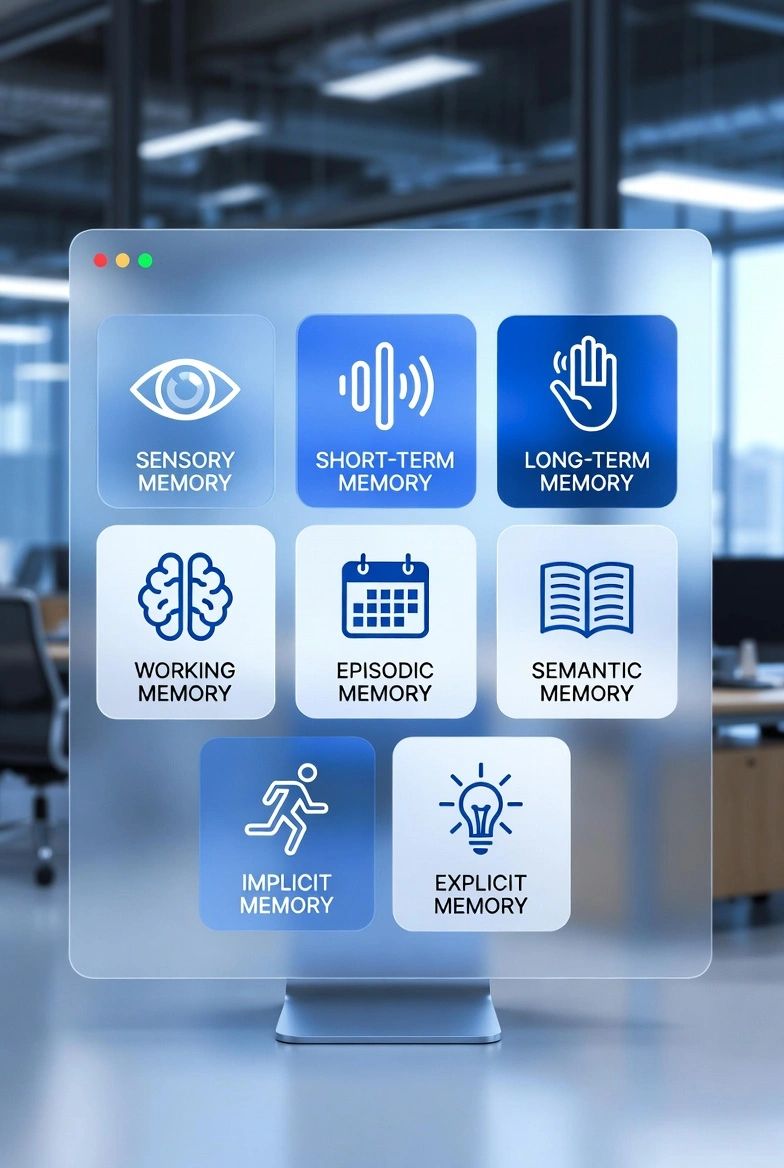
Human memory isn’t a single mechanism. It’s a layered, purpose-built system:
- Working memory holds the last few moments of experience—the words someone just said, the question we were about to ask. It is fast, fragile, and essential for fluid conversation.
- Short-term or intermediate memory stores events from the past hours or days. This layer allows us to form continuity, remember what someone told us earlier in the day, and understand how we’re feeling now in relation to yesterday.
-
Long-term autobiographical memory holds our core story: family, personal history, preferences, and the emotional significance of the people we love.
Artificial memory does not reproduce these biological mechanisms. But if it’s going to be useful—and safe—it must mimic the function of these layers. It must know what to capture immediately, what to enrich with context, and what to store as part of the long-term identity of the user.
This selectivity is at the heart of trustworthy AI.
Why AI Memory Is So Hard to Build
Despite all their abilities, large language models do not actually remember anything. They generate text based on patterns, not experiences. Every time they respond, they do so from scratch unless the relevant information is explicitly re-supplied in the prompt.
That means true AI memory must be built outside the model.
It must collect information from conversations and experiences, decide what matters, and store it reliably. It must integrate new facts while avoiding duplication and preventing hallucinations. It must ensure privacy. And it must be able to retrieve the right memory quickly, safely, and in context.
Not everything a user says should become memory.
“I’m hungry” should not.
“My daughter Emily is three” should.
Artificial memory must be curated, not accumulated.
It must protect identity rather than distort it.
It must guard against reinforcing false beliefs.
And it must ensure that help arrives only when helpful—not in a way that overwhelms or confuses.
This is where simple “LLM memory” solutions fail—and where mem0-style systems begin to offer useful structure.
What mem0-Style Systems Get Right
mem0 provides a structured foundation for persistent AI memory. It turns experiences into discrete “memory objects” with text content, timestamps, metadata, and vector embeddings. It supports semantic search so similar memories cluster together and become discoverable. It lets the system retrieve relevant memories based on meaning, not just keywords. It provides update paths so memories can evolve instead of remaining static.
In the Voice of Reason architecture, mem0 serves as the core persistence layer. A unified storage interface allows this backend to be swapped or extended, but mem0 is currently the most powerful option for maintaining structured, vector-searchable memory.
It gives us the building blocks—but assistive technology demands something more: a system that is layered, cautious, selective, and deeply aligned with the emotional needs of vulnerable users.
How Voice of Reason’s Memory Architecture Actually Works
The Companion’s memory system is much more than a simple store-and-retrieve mechanism. It consists of coordinated subsystems, each with a distinct role in transforming raw experiences into meaningful, safe, long-term memory.
A unified storage layer with semantic search
All memory operations are funneled through a unified storage interface that abstracts away the underlying database. The current backend uses mem0, which supports both structured metadata and vector-based semantic search. Memories are stored with rich metadata—such as type, timestamps, and relationships—so the system can distinguish between voice memories, transcripts, biography chapters, images, and other content.
A dedicated voice-memory ingestion pipeline
When the Companion detects that something important has been said, it sends the transcript into a voice-memory processing pipeline. Here the raw text is cleaned, normalized, and enriched. Topics, emotions, dates, durations, locations, and titles are inferred. The result is stored as a structured voice memory, while each transcript segment is also stored individually for transparency and traceability.
This gives the system a high-resolution view of what happened, not just a summary.
An integration service for long-term biography
Once a voice memory is created, an independent integration process retrieves the user’s existing biography and evaluates where this new event belongs. Should it become part of an existing chapter? Should a new chapter be created? This decision is made with the help of an LLM designed specifically to maintain narrative coherence.
The system maintains chapter metadata such as time periods, memory IDs, and themes. After updating the biography, caches are refreshed so the conversational agent and UI always reflect the user’s latest life story.
Conversation-aware memory retrieval
When the user asks a question, a search tool queries the memory system across biography chapters, voice memories, and image analyses. Results are filtered, ranked, and contextualized. The system favors long-term chapters for deep context and voice memories for recent events. If relevant images exist, they are referenced as part of the memory.
Semantic search ensures that even if the user phrases something differently, the right memory still surfaces.
A memory viewer that reconstructs the user’s story
A dedicated endpoint assembles the entire memory graph: transcript segments linked to voice memories, voice memories linked to chapters, and chapters forming the biography. A lightweight cache provides rapid access for repeated viewing without flooding the memory backend.
Multimodal ingestion
Images can be analyzed, with metadata and descriptions stored as memories alongside extracted timestamps. Documents (including PDFs) can be imported and broken down into chapters, allowing external archives to seed or enrich the user’s biography.
Together, these subsystems form a memory pipeline that is layered, deliberate, and aligned with human cognition.
Memory Designed for Vulnerable Users
Artificial memory cannot be careless. It must never fabricate. It must protect the user from confusion rather than causing it. In Voice of Reason’s Companion, memories must be earned, not assumed. Significant events must be validated and enriched before they enter the long-term biography. The system ensures transparency, traceability, and correctness. It approaches memory as a safety-critical feature—not a convenience.
This is what differentiates a clinical-grade assistive AI from a conversational toy.
Designing Memory Is Designing Trust
True artificial memory must overcome the stateless nature of LLMs, decide what deserves preservation, and retrieve only what serves the user’s wellbeing. When done well, memory forms the emotional backbone of an assistive AI. It helps restore autonomy, preserve identity, reduce fear, and provide stability in a world that may no longer feel predictable.
Voice of Reason’s Companion—supported by a mem0-enabled persistence layer, a structured enrichment pipeline, and a biography-driven consolidation process—brings us closer to an AI that does not merely respond to people, but remembers them.
In remembering, it becomes not just an assistant, but a gentle anchor for those navigating cognitive challenges.