What is a Memory? Building Human Connection Through AI Memory Systems
At VoiceOfReason.ai, we often ask ourselves a deceptively simple question: What is a memory?
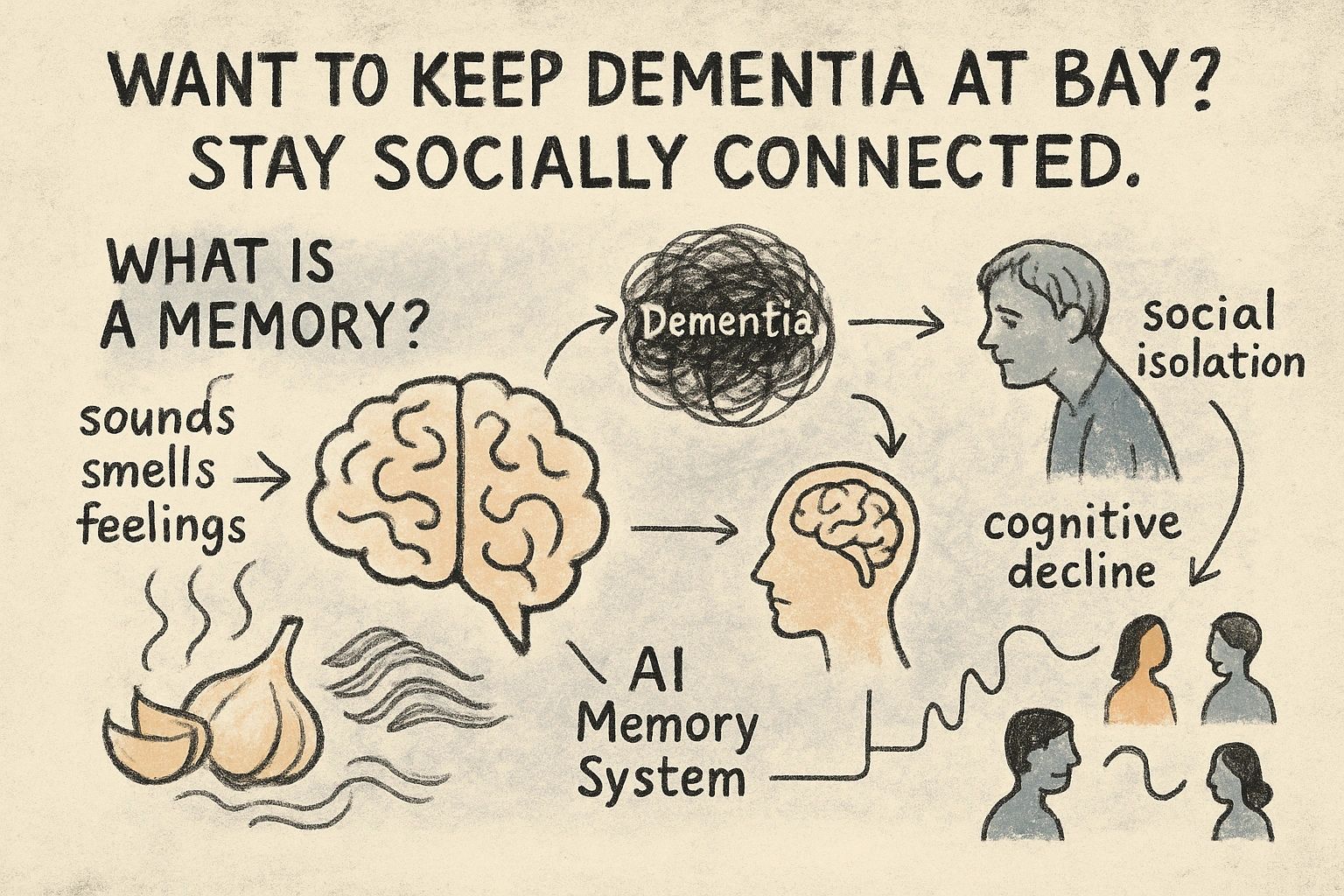
For humans, memory is never just facts and figures. When you recall your mother’s kitchen, you don’t only remember the countertops or the layout – you remember the smell of garlic sizzling in butter, the clink of her favourite pan, her humming as she cooked, and the feeling of warmth and safety. Memories are emotional tapestries, woven from smells, sounds, feelings, faces, and the stories you told yourself about the moment.
But when dementia sets in, these tapestries begin to unravel. As memory fades, so too does social interaction. Friends stop calling when their name is forgotten; family feels awkward when stories are repeated; and the person themselves retreats further into isolation. This is a devastating, vicious cycle – one where loneliness accelerates cognitive decline.
Recent studies paint a stark picture:
-
Loneliness and Social Isolation Increase Dementia Risk.
Socially isolated older adults have a 27% higher chance of developing dementia, including Alzheimer’s, compared to their socially connected peers. Loneliness itself increases Alzheimer’s risk by 31%, comparable to smoking or physical inactivity. -
Biological Amplification of Alzheimer’s.
Loneliness is linked to higher amyloid-beta plaque build-up and tau tangles in the brain, both key markers of Alzheimer’s pathology. It also correlates with reduced grey matter in areas critical for memory and social perception, like the hippocampus. -
Accelerated Decline.
For those already living with Alzheimer’s, loneliness accelerates cognitive decline, worsens memory loss, and increases daily functioning challenges. This is not just emotional – it is biological, compounding stress-related inflammation and reducing cognitive reserve. -
A Bidirectional Trap.
Alzheimer’s drives social withdrawal, which fuels further loneliness, worsening symptoms in a brutal feedback loop. Studies show that perceived loneliness, even more than objective isolation, predicts faster dementia progression.
Breaking the Cycle with Memories
At VoiceOfReason.ai, we are determined to break this cycle with our upcoming VoiceBook, formerly known as AI Biographer. The idea is simple yet profound: enable family, friends, caregivers, and even strangers to engage through memories.
But building such a system is not trivial. Memory is not a spreadsheet. It is closer to an interactive, emotional knowledge graph, where:
- Smells are linked to places
- Places are linked to people
- People are linked to feelings
- Feelings are linked to entire phases of life
When our VoiceBook listens to a conversation, it does not merely transcribe words. It processes speech, retrieves contextually relevant memories, and constructs outputs with emotional resonance. For instance, if John mentions “I used to fix bikes with Michael,” the system retrieves not only “Michael is his son” but also memories tagged with emotional context, ensuring conversations remain personal, dignified, and life-affirming.
How Does an AI Memory System Work?
From the inside, our VoiceBook combines:
- Speech-to-text pipelines to convert real-time speech into usable text streams.
- Large Language Models (LLMs) to interpret meaning, emotional undertones, and conversational intent.
- RAG (Retrieval-Augmented Generation) modules to retrieve memories from biographies, daily mid-memories, and previous conversations.
- Prompt Management and Deduplication tools to keep responses natural and non-redundant.
- Memory Validation and Integration systems that ensure only verified, significant, and socially useful information is retained.
But perhaps equally important is how these memories are delivered back.
The Power of Emotional Text-to-Speech
If our VoiceBook merely spoke memories in a flat, robotic voice, it would fail to convey their essence. Memory is inherently emotional. The warmth in your grandmother’s lullaby, the pride in your father’s voice recalling your graduation, or the humour in a sibling’s teasing – these are feelings as much as words.
That’s why we are building advanced text-to-speech systems using services like rime.ai that are capable of conveying the emotional content of memories – sadness, joy, wonder, pride, tenderness – in ways that encourage real empathy, understanding, and human-like interaction.
This is not just “reading out text”; it is speaking with feeling, allowing our AI to act as a bridge of compassion and connection between caregivers, loved ones, and those living with dementia. A voice with emotional nuance helps unlock memories buried under confusion and makes conversations feel natural, safe, and dignified.
Why We Need More Than Facts
If our VoiceBook merely recalled facts – birth dates, addresses, or names – it would be a cold database. But memory is what makes us human. It is why we cry listening to an old song or feel at home in a smell. Recreating this digitally requires interactive LLM architectures, emotionally rich data storage, and voices that can speak with the warmth and nuance of human conversation.
To build this, we are working with pioneering partners like mem0, Rime.ai, and a host of cognitive AI platforms to achieve a human-like way of remembering, retrieving, and sharing memories interactively and empathetically.
The Future of AI Memory for Dementia and Loneliness
The science is clear: loneliness and Alzheimer’s feed off each other in a brutal cycle, but social bonds can break it. Regular social interaction bolsters cognitive reserve, delays Alzheimer’s onset, and mitigates symptom progression.
At VoiceOfReason.ai, our VoiceBook is designed to energize social interactions, enabling loved ones to engage deeply, caregivers to maintain connection, and strangers to become part of meaningful conversations.
Because at the end of the day, memory is not just about the past. It is about connection, love, and what makes us who we are – today and always. And to honour that, we are building AI that not only remembers, but recalls feelings.