🧠 Building a Biography from Scattered Memories: The Journey from Chaos to Coherence
Imagine sitting down to write the story of your life. Do you begin with, "I was born in..."? Or do you find yourself instead reminiscing about the way your grandmother’s perfume lingered in a room, the first time you crashed a bike, or the face of a friend you haven’t thought about in years?
For most people—especially those with dementia, traumatic brain injury, or learning disabilities—life doesn’t unfold in perfect chronological order. Memories come in waves, often triggered by a smell, a photograph, or a sound. And that’s exactly why Voice of Reason is developing a new way to construct biographies—not as a rigid timeline, but as an emotional tapestry woven from any memory that surfaces, in any order.
💡 Rethinking Memory: Life Is Not a Linear Script
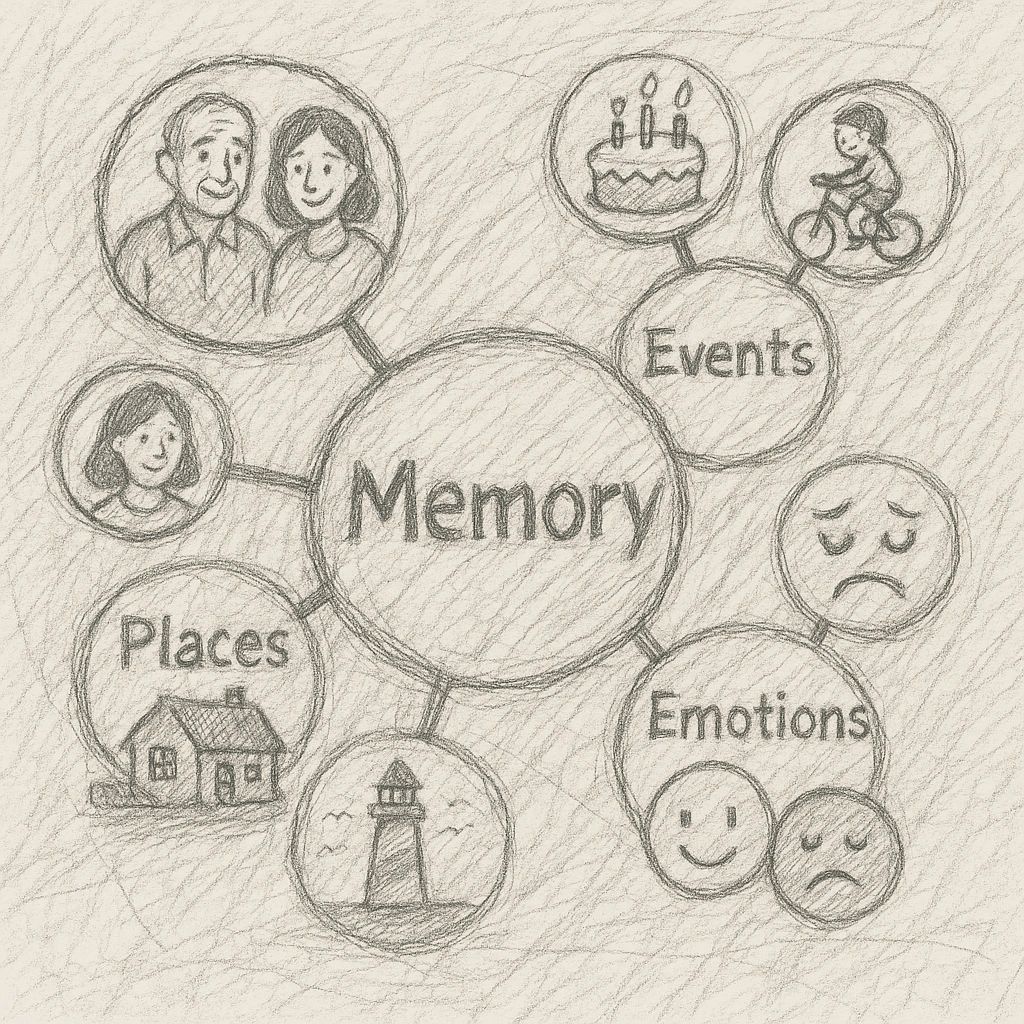
Our cognitive architecture doesn’t store life as an ordered list. We don’t have a chapter called “1983” neatly filed between “1982” and “1984.” Memories are linked in nonlinear, often surprising ways—by emotions, locations, people, or even sounds.
When you start to tell your story, it might go like this:
“I was thinking about this song I heard the other day... it reminded me of when I met Mary at the county fair.”
No date. No place. Just an association. And that’s okay. It’s deeply human.
🧬 The Voice of Reason Approach: Biographies as Living Memory Maps
Our system embraces this chaotic beauty. At its core is a memory engine that allows users to recall anything, in any order. It doesn't force structure upfront—it listens, collects, and then organizes retroactively.
Here's how we do it:
-
Freeform Memory Input
Whether spoken aloud, typed, or recalled in passing conversation, memories are captured in real-time. We don’t judge whether they’re complete—we just catch them as they come. -
Contextual Clustering & Emotional Tagging
Using a custom LLM processor, our system (as seen in the and modules) tags each memory with themes: people, events, places, or emotions. This lets us group them naturally, even when dates are missing. -
Mid-Memory Storage
New memories are stored in a working memory space where fragments await validation. Entries tagged with and prioritized if they reflect life changes or milestones. -
Chronological Anchoring
If a memory includes a date or a verifiable event (e.g., “the year Emily was born”), we anchor it. If not, we still keep it—but loosely tied to emotional or thematic threads. -
Integrated Biography Generation
When a user or caregiver wants to see the full story, theBiographyManagerintelligently assembles the entries—not as a strict timeline, but as a readable, flowing narrative. Emotional consistency and relevance take precedence over timestamp precision. -
Vector Embedding + Retrieval (RAG)
Even vague memories (“that vacation with the red lighthouse”) can be connected to fuller stories using retrieval-augmented generation and semantic similarity tools like Chroma. This makes recall feel intuitive and even surprising—just like real memory.
🖼️ What About Photos, Audio, and Context?
Our future roadmap includes integrating media:
- Photos linked via metadata (faces, locations, events)
- Audio cues (e.g., “play the song we danced to at our wedding”)
-
Historical overlays to tie memories into world events (“You mentioned 1969—did you mean during the moon landing?”)
The goal: enrich every memory fragment with supporting sensory and contextual data to make it more vivid and easier to recall.
🧩 Writing the Biography: From Memories to Meaning
Ultimately, the biography we help create isn’t just a record of events. It’s a guided journey through selfhood, where the user leads the way.
We don’t start with “Where were you born?”—we start with whatever memory arises. The system then builds bridges around that moment: who was there, what mattered, how it felt. Over time, those bridges form a readable, emotionally coherent narrative.
Not a Q&A database. Not a sterile fact sheet.
But a life—told the way it’s remembered.
❤️ Why This Matters
For people with memory challenges, recalling the past isn’t just nostalgic. It’s a form of self-preservation. By letting people explore their story in the way their brain naturally remembers it, we preserve identity, dignity, and joy.
Voice of Reason isn’t just building tools. We’re crafting mirrors—reflecting back the stories that make someone whole.