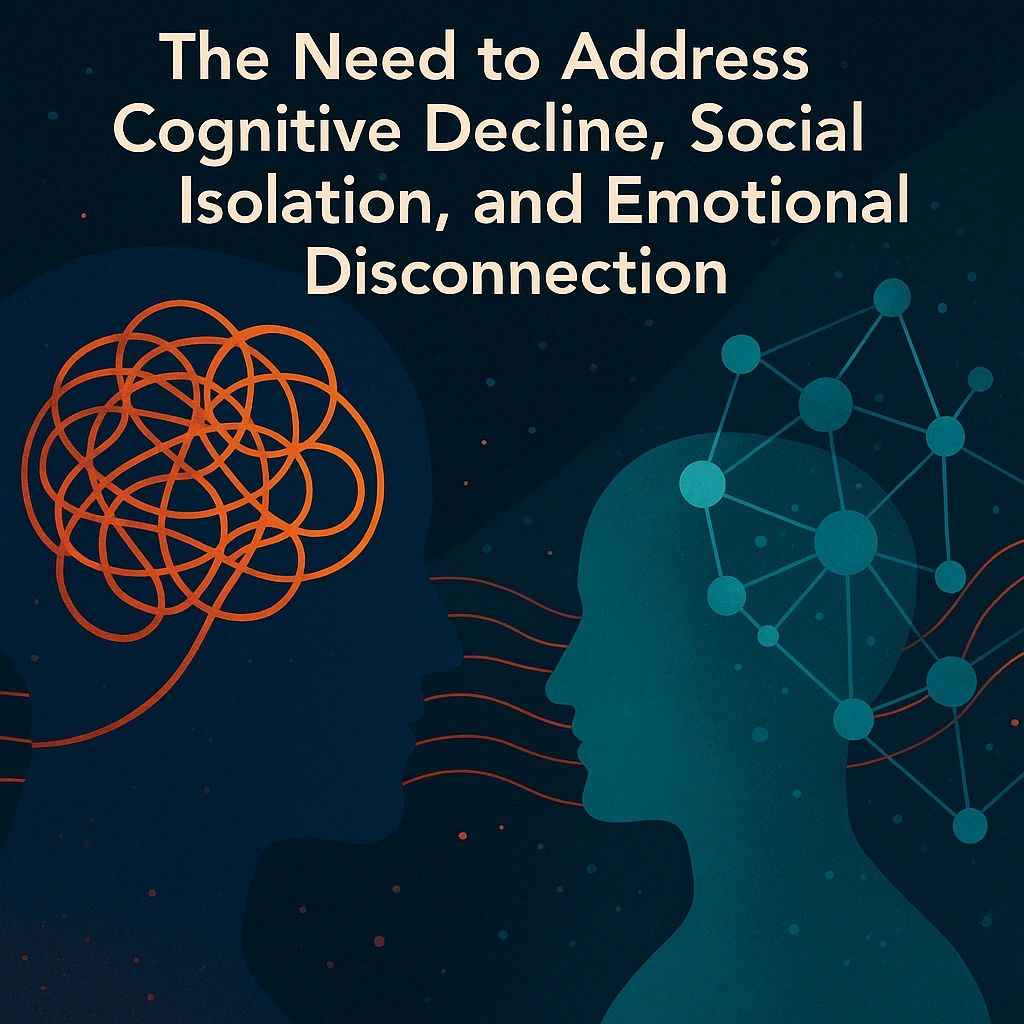
It Isn’t Just a Technical Ambition — It’s a Lifeline
“Sleep problems don’t just cause dementia — they amplify its grip.”
— from LinkedIn post by Reza
The connection between sleep, cognition, and social well-being is more than medical fact — it’s a reality lived every day by those experiencing cognitive decline, social isolation, or traumatic brain injury. And if you’ve ever watched someone you love slowly lose access to memory, language, or autonomy, you know how deeply the smallest barriers — like forgetting a wake word or struggling to open an app — can fragment their world.
That’s why we’re building something radically simple, but profoundly powerful:
Ambient, interface-less AI.
Why "Ambient" Matters
We’re not developing another assistant you need to tap, wake, or summon. We’re building a system that listens when you’re ready to talk, that speaks when you’re alone, and that connects when connection matters most. No buttons. No commands. No screens. Just awareness — gentle, contextual, and always on.
Our first product — moving from Alpha 0 to Alpha 1 — already combines:
- ✅ Real-time speech-to-text and response generation
- ✅ Deep context via retrieval-augmented generation (RAG)
- ✅ Multi-model prompt orchestration across OpenAI, Anthropic, Google, and Cerebras
- ✅ A growing memory layer that recalls facts, relationships, and significant life events
These aren’t just engineering feats. They’re cognitive ramps — tools to reduce friction for those who forget words, lose attention, or live in moments of confusion.
Early Detection, Without Intrusion
The beauty of ambient AI is its stealth. If done right, it doesn't just help — it watches quietly for patterns:
- Subtle changes in speech cadence that precede mood swings or depressive episodes
- Decreasing conversational frequency that signals social withdrawal
- Night-time interactions that reveal sleep fragmentation
- Conversational gaps pointing to short-term memory loss
Our platform — already embedding deduplication, chunk-based context filtering, and stateful memory — paves the way for early warning systems. Not by issuing alerts. But by noticing gently, nudging compassionately, and helping caregivers before a crisis unfolds.
Why This Is Hard (But Worth It)
Creating an ambient system that doesn’t feel like surveillance but still delivers high-context personalization is a razor-thin balance. We’re navigating:
- ⚙️ Real-time LLM chaining across hint generation, fact consolidation, and memory integration
- 🧠 Mid-memory modeling with precision filtering for clinically significant events (not trivia)
- 🧩 Dynamic RAG pipelines that update context without duplication or confusion
- 🧭 Empathetic state tracking — because what someone says isn’t always what they mean
From memory_manager.py to llm_processor.py, every component in our stack reflects a belief:
The future of care isn’t transactional — it’s relational.
From Voice to Vigilance: What Comes Next
Our roadmap from Alpha 1 will begin to lean into preventive care: detecting early signs of delirium, sundowning, or emotional disengagement. The same foundation we use to power ambient conversation will begin to extend into areas like:
- 🌙 Sleep health support
- ❤️ Emotional regulation nudges
- 🧠 Cognitive load balancing
- 🏠 Home safety monitoring, without the noise
We’ll do this with no screens. No UX flowcharts. Just presence.
This Isn’t Just a Product. It’s a Promise.
The road is steep. We’re still early. Our Alpha 1 milestone is just the beginning. But we’ve seen what happens when someone hears exactly what they need — at the right moment — and remembers who they are.
That’s the power of ambient AI when done well.
It’s not just clever.
It’s life-changing.