Everyone seems amazed by how quickly artificial intelligence is advancing.
I understand why.
A few years ago, most people had never held a meaningful conversation with a computer. Today an AI can write software, analyze an image, translate languages, summarize a thousand-page document, reason over complex information, generate photographs and video, and converse in a way that occasionally makes you forget there is no person on the other side.
The natural reaction is:
How did AI advance so quickly?
But lately I have been wondering whether that is the wrong question.
Maybe we should be asking:
Why did it take us so long?
Because when you look backward, something strange becomes apparent.
Much of the mathematics behind modern artificial intelligence is not new.
The basic idea of artificial neural networks is not new.
Parallel computing is not new.
Graphics processors have been around for decades.
The Internet gave us enormous amounts of digital information years ago.
So why didn't we have genuinely useful conversational AI thirty years ago?
The answer tells us something important not only about artificial intelligence.
It tells us something about innovation itself.
And perhaps something uncomfortable about human nature.
The mathematics was waiting for us
At the heart of modern AI are enormous numbers of mathematical operations involving vectors, matrices, probabilities and optimization.
We sometimes talk about these things as if they were born alongside ChatGPT.
They weren't.
The roots of solving systems of linear equations go back more than two thousand years. Ancient Chinese mathematicians used methods recognizable as predecessors to modern elimination techniques. The formal mathematics of matrices and what we now call linear algebra developed much later, particularly from the seventeenth through nineteenth centuries, but the mathematical ancestry is ancient. (History of matrices)
Even neural networks are hardly new.
The foundations go back to the 1940s and 1950s. Frank Rosenblatt's perceptron appeared in the 1950s. And in 1986, David Rumelhart, Geoffrey Hinton and Ronald Williams published their famous work describing backpropagation—essentially a method for allowing a multilayer neural network to adjust itself based on its errors. (Neural-network history; 1986 backpropagation paper)
That was forty years ago.
So again:
What were we waiting for?
Ironically, video games helped build the machine
One of my favorite parts of the AI story is that one of its most important enabling technologies wasn't originally built for artificial intelligence.
It was built largely because people wanted better graphics.
Video games wanted more realistic worlds.
Computer graphics required something unusual. A conventional CPU is very good at doing sophisticated sequences of instructions. Rendering graphics requires performing relatively simple mathematical operations on huge numbers of pixels, vertices and other elements simultaneously.
That rewarded parallel processing.
The graphics industry kept demanding more.
More polygons. More pixels. More lighting. More realism. More frames per second.
That commercial demand pushed graphics hardware into increasingly massive parallel computation.
NVIDIA describes its origins explicitly around 3D graphics and gaming. In 1999 it marketed the GeForce 256 as a GPU. By the early 2000s, parts of graphics pipelines had become programmable. Then in 2006 NVIDIA unveiled the CUDA architecture, opening a path toward using GPUs more directly for general-purpose scientific and computational workloads. (NVIDIA timeline)
Researchers had begun recognizing something important.
The same architecture that could calculate what millions of pixels should look like could also perform the matrix operations needed by neural networks.
Ian Buck, whose work helped lead toward CUDA, has described researchers around 2000 looking at graphics processors and recognizing their potential for matrix multiplication and linear algebra. (Ian Buck on GPU computing)
Think about that for a moment.
Millions of people buying graphics cards so they could play increasingly realistic computer games were helping finance the development of the computational architecture that would eventually help power modern artificial intelligence.
There is something wonderful about that.
We rarely know what an invention is ultimately for when we first invent it.
But if we had the mathematics and the GPUs, where was ChatGPT?
Here is where my original question needs qualification.
The ingredients were not quite all there thirty years ago.
Graphics accelerators existed, but they weren't yet the flexible general-purpose parallel computers GPUs later became.
Neural networks existed, but training deep networks was difficult.
Backpropagation existed, but architecture, data, optimization and computing power were still limiting factors.
Storage was expensive.
Network bandwidth was limited.
The Web was tiny compared with what it later became.
The software infrastructure for distributing enormous training jobs across thousands of processors didn't exist.
Then, piece by piece, the puzzle changed.
GPUs became programmable.
CUDA made them easier to use for general computation.
Deep-learning techniques improved.
In 2012, GPU-powered AlexNet helped demonstrate dramatically what deep neural networks could do for image recognition. (AlexNet paper)
And then something happened in 2017 that is especially important to the current AI revolution.
A group of researchers published a paper called Attention Is All You Need.
They introduced the Transformer.
Its architecture was not merely better at certain language problems. It was particularly well suited to parallel computation. The original researchers emphasized that it could be trained much more efficiently than the recurrent approaches that dominated sequence modeling at the time. (Attention Is All You Need)
Now the machine, the mathematics and the architecture began fitting together remarkably well.
Then came scale.
Researchers discovered increasingly predictable relationships among model size, training data and computational power. Work on neural scaling laws showed that increasing those resources could produce remarkably systematic improvements in performance. Later work showed that the relationship between model size and the amount of training data mattered enormously too. (Neural scaling laws; Compute-optimal training)
That changed the economics of AI.
If spending ten or one hundred times more on computation gave a somewhat predictable improvement, suddenly it became rational to raise enormous amounts of capital and build enormous computing systems.
A research project became an industrial project.
And that is when everything began moving very quickly.
Innovation is rarely one invention
This is the larger lesson.
We tend to imagine innovation as someone walking into a laboratory one morning and inventing something entirely new.
Most important innovation does not work that way.
The components often exist first.
Someone eventually sees how they fit together.
That distinction fascinates me.
The telephone required discoveries in electricity, acoustics and materials.
The automobile required metallurgy, petroleum refining, mechanical engineering and manufacturing.
The smartphone required semiconductors, radio networks, batteries, touchscreens, cameras, satellite navigation, operating systems and the Internet.
None of those components alone produced the smartphone.
Innovation happened when somebody assembled them differently.
Artificial intelligence may be one of the greatest examples of this phenomenon we have ever seen.
Ancient mathematics. Decades-old neural-network ideas. Graphics processors developed largely for gaming. The Internet. Cheap storage. Massive data centers. New architectures. New software. Enormous capital.
And then the people who were willing to put everything together and ask:
What happens if we make this much bigger?
This is where I think about Einstein
Albert Einstein is an irresistible example, although the popular version of the story is a little too simple.
Einstein was not the only physicist thinking about the problems that eventually produced relativity.
Lorentz, Poincaré, Maxwell and others had already developed important mathematical and experimental pieces. (Einstein and relativity)
That makes Einstein more interesting to me, not less.
The extraordinary achievement wasn't that he possessed information unavailable to every other human being.
Much of the information was sitting there.
Other extraordinarily capable scientists could see it.
Einstein arranged it differently.
He questioned assumptions other people treated as fixed.
The equation associated with his insight, E = mc², looks almost absurdly simple.
But a simple equation is not the same thing as a simple discovery.
The difficult part was not manipulating three symbols.
The difficult part was seeing reality differently enough that those symbols became inevitable.
That is innovation.
The pieces can be visible to everybody while the pattern remains visible to almost nobody.
Perhaps innovators are really pattern breakers
This makes me wonder whether we give too much attention to intelligence and too little attention to intellectual independence.
The innovator often has to say:
What if everyone is solving the wrong problem?
What if this tool built for one industry belongs in another?
What if the assumption underneath this entire field is wrong?
What if something everyone says is impossible is merely difficult?
What if ten technologies that already exist become a new technology when combined?
Those questions sound obvious after the breakthrough.
Before the breakthrough, they can make someone sound ridiculous.
That creates a problem.
Because human beings are not naturally neutral toward ideas that threaten established assumptions.
We have a well-documented tendency toward what researchers call status quo bias—a disproportionate preference for keeping things as they are. Samuelson and Zeckhauser demonstrated this experimentally decades ago. (Status quo bias study)
Some of that caution is understandable.
Experimentation is dangerous.
If your ancestors tried every unknown mushroom they encountered, your family tree probably ended early.
Societies need stability.
Organizations need predictability.
Engineering needs standards.
Medicine needs evidence.
Safety matters.
But the same instincts that protect us from reckless change can become extraordinarily efficient machinery for suppressing useful change.
The tall flower problem
There is a cultural metaphor sometimes called Tall Poppy Syndrome: when one flower grows conspicuously above the others, people feel an urge to cut it down. A related Japanese proverb is often translated as:
“The nail that sticks up gets hammered down.”
The specific cultural origins differ, but the human tendency is recognizable almost everywhere. (Tall poppy: Australian National Dictionary Centre)
Organizations do it.
Industries do it.
Academic disciplines do it.
Governments do it.
Sometimes entire societies do it.
Someone proposes something unusual.
First we say it is impossible.
Then we say it is irresponsible.
Then we explain why the existing system cannot accommodate it.
Then somebody succeeds.
And eventually everybody explains why the breakthrough was obvious.
We remember the successful innovators afterward as geniuses.
We forget how inconvenient many of them looked beforehand.
AI itself has already lived through this cycle
Artificial intelligence has experienced periods of extraordinary optimism followed by disappointment and retreat.
The perceptron generated enormous excitement in the 1950s.
Then its limitations became clearer.
Funding and interest fell.
Neural-network approaches spent years outside the center of the field.
Yet many of the ideas returned.
By the mid-1980s, multilayer networks and backpropagation helped revive the field. Decades later, vastly greater computational power allowed descendants of those ideas to become transformative. (Neural-network history)
That history should make us humble.
Sometimes an idea fails because it is wrong.
Sometimes it fails because it is early.
And those are extremely difficult to distinguish at the time.
Look at what suddenly seems normal
Consider what has happened within one lifetime.
Reusable orbital-class rocket boosters were once regarded as extraordinarily difficult. SpaceX landed an orbital-class Falcon 9 first stage in 2015 and flew one again in 2017. Reuse is now part of regular operations. (SpaceX flight milestones)
Fully autonomous ride services are now carrying members of the public in multiple American cities. By 2026, Waymo was operating or introducing fully autonomous passenger service across numerous metropolitan areas. (Waymo service update)
Cochlear implants can electrically stimulate the auditory nerve and provide a sense of sound to people who are profoundly deaf, although they do not restore normal hearing. (NIDCD: cochlear implants)
Researchers are experimentally implanting electrode systems in the visual cortex of people who are blind to determine whether electrical stimulation can produce useful visual percepts. That work remains experimental—we should not describe it as restoring normal sight—but consider what the sentence itself would have sounded like a generation ago. (Experimental visual-cortex study)
And now we carry artificial intelligences in our pockets capable of doing things that would have looked like science fiction when I was young.
These technologies are imperfect.
Some will disappoint us.
Some will cause new problems.
Some will be abused.
But taken together, we are clearly entering an unusual period in human technological development.
Which makes me worry about the lawn mower.
Are we about to cut the flowers down again?
When technological change becomes fast enough, people become frightened.
Some of that fear is justified.
Powerful technologies require powerful safeguards.
Artificial intelligence should be tested.
Autonomous vehicles should prove safety.
Medical technology should require evidence.
Brain implants deserve enormous ethical scrutiny.
AI systems working with older adults, people with dementia, or other vulnerable populations should be designed with privacy, consent, dignity and human oversight in mind.
I believe all of those things.
But there is a profound difference between guardrails and paralysis.
We need guardrails.
We do not need guard towers surrounding every new idea.
The danger is that society can become so focused on preventing every possible misuse of a technology that we also prevent its beneficial use.
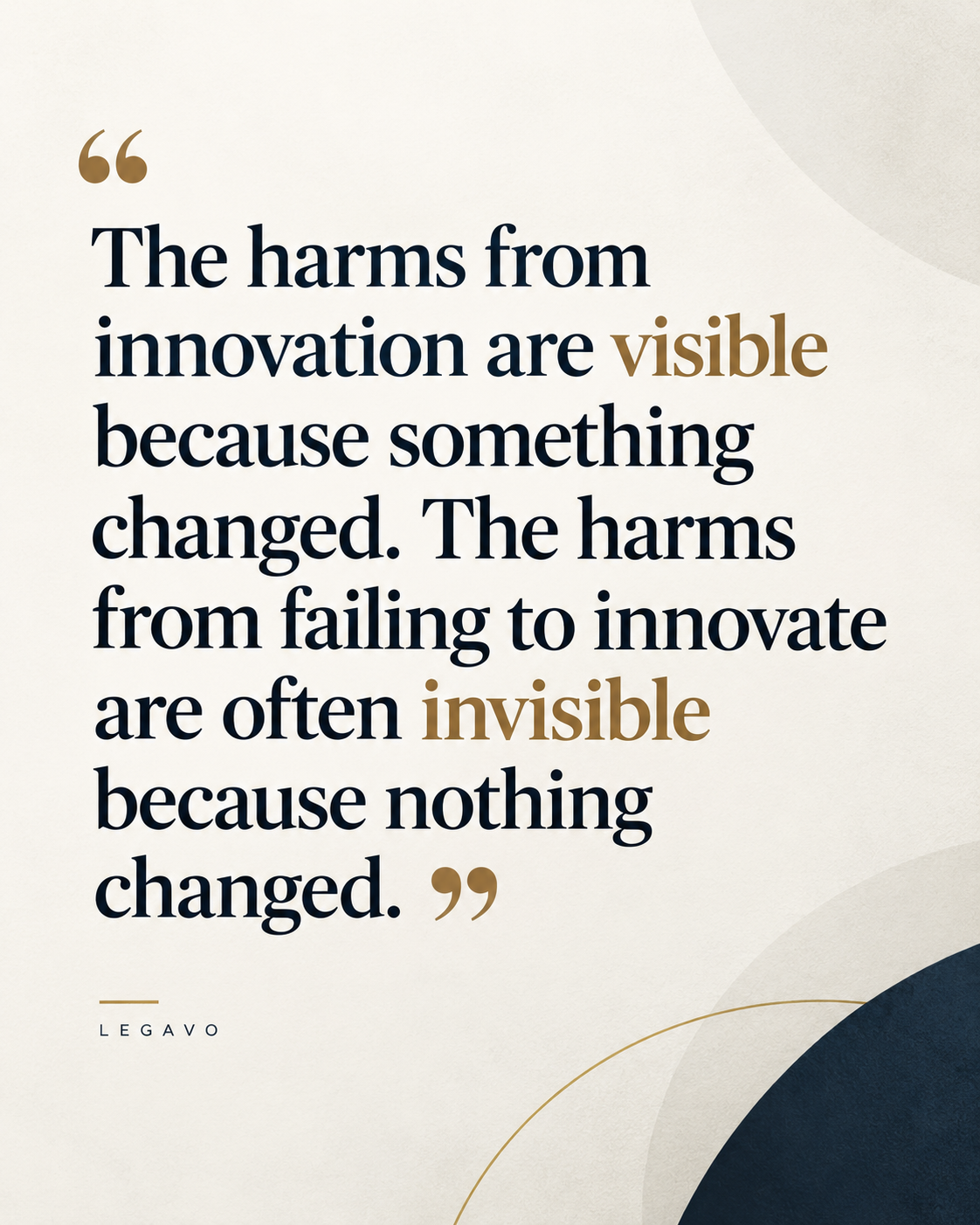
The harms from innovation are visible because something changed.
The harms from failing to innovate are often invisible because nothing changed.
A disease remains uncured.
A dangerous job remains dangerous.
An older person loses independence sooner than necessary.
A family caregiver burns out.
A child remains unable to communicate.
A scientific problem remains unsolved.
Nobody holds a press conference for the invention that was never allowed to happen.
This matters to how I think about Legavo
This question is deeply relevant to what we are trying to do at Legavo, although I do not believe the lesson is that we have invented some magical new branch of artificial intelligence.
Quite the opposite.
Many of the technical components already exist.
Speech recognition exists.
Text-to-speech exists.
Large language models exist.
Computer vision exists.
Memory systems exist.
Cloud computing exists.
Photographs, messaging and video calling obviously exist.
What interests us is what happens when those pieces are assembled around a very particular human problem.
Can a conversational system understand not merely language, but enough of a person's history, relationships, photographs and preferences to become genuinely useful?
Can it remember a story rather than force the person to explain themselves again tomorrow?
Can it help someone with cognitive challenges manage an ordinary day without making that person feel like they are operating a computer?
Can it help preserve a memory?
Can it recognize that a photograph might start a meaningful conversation?
And perhaps most importantly:
Can the AI recognize when another human being would be better—and help that connection happen?
That is increasingly how we describe the work. Legavo Companion is being developed around contextual conversation, personal photographs, everyday guidance and a Caregiver interface that allows family to participate from a distance. (Current Legavo overview)
None of those ingredients alone is revolutionary.
The question is whether their arrangement can be.
That may be one of the most misunderstood things about innovation.
You do not always have to invent a new piece of physics.
Sometimes you have to notice that the pieces already on the table have never been assembled around the right human need.
Innovation needs skeptics—but it also needs believers
I do not want a world in which every inventor is automatically believed.
That would be ridiculous.
For every brilliant unconventional idea, there are thousands of bad unconventional ideas.
Skepticism is essential.
Scientific replication is essential.
Regulation can be essential.
Ethics are essential.
The answer to Tall Poppy Syndrome is not to declare every tall weed a flower.
The answer is to create systems capable of telling the difference.
That means giving serious new ideas room to be tested rather than requiring them to be accepted or destroyed immediately.
It means tolerating failure.
It means allowing people to challenge assumptions without treating disagreement as disloyalty.
It means investors accepting that transformative ideas initially look risky.
It means established companies being willing to cannibalize their own products.
It means regulators understanding both sides of risk: the risk of allowing something harmful and the risk of delaying something beneficial.
And it means remembering that consensus is extraordinarily useful for maintaining systems but not always for inventing their replacements.
Maybe this is the real question
I started by asking why artificial intelligence advanced so quickly.
After looking at the history, I think the more interesting answer is:
It didn't.
It took generations.
The mathematics took centuries.
Neural networks took decades.
The computing architecture took decades.
The algorithms accumulated. The data accumulated. The infrastructure accumulated. The money accumulated.
Thousands of researchers made incremental advances.
A gaming industry accidentally helped finance the parallel-computing revolution.
And then, eventually, enough pieces arrived in the hands of enough people willing to combine them.
From the outside, the result looked sudden.
That is how innovation often appears.
A flower spends a long time below the surface.
Then one morning everyone notices that it has grown taller than the others.
Our instinct should not be to immediately reach for the mower.
Because right now, across artificial intelligence, robotics, medicine, transportation, spaceflight and neurotechnology, I suspect there are many more pieces sitting on the table.
Somebody is going to arrange them differently.
Somebody is going to propose something that sounds unreasonable.
Somebody is going to challenge an assumption that an entire industry regards as obvious.
Some of those people will be wrong.
A few of them may be spectacularly right.
The question for the rest of us is whether we give them enough room to find out.
Perhaps the most important technologies of the next twenty years do not require us to invent all the pieces.
Perhaps the pieces are already here.
And perhaps the thing we should worry about most is whether, when somebody finally sees how they fit together, we will help the flower grow—
or cut it down.